Table of Contents
AI Summary
Cosori vs Ninja Air Fryer: Which Brand Should You Actually Buy?
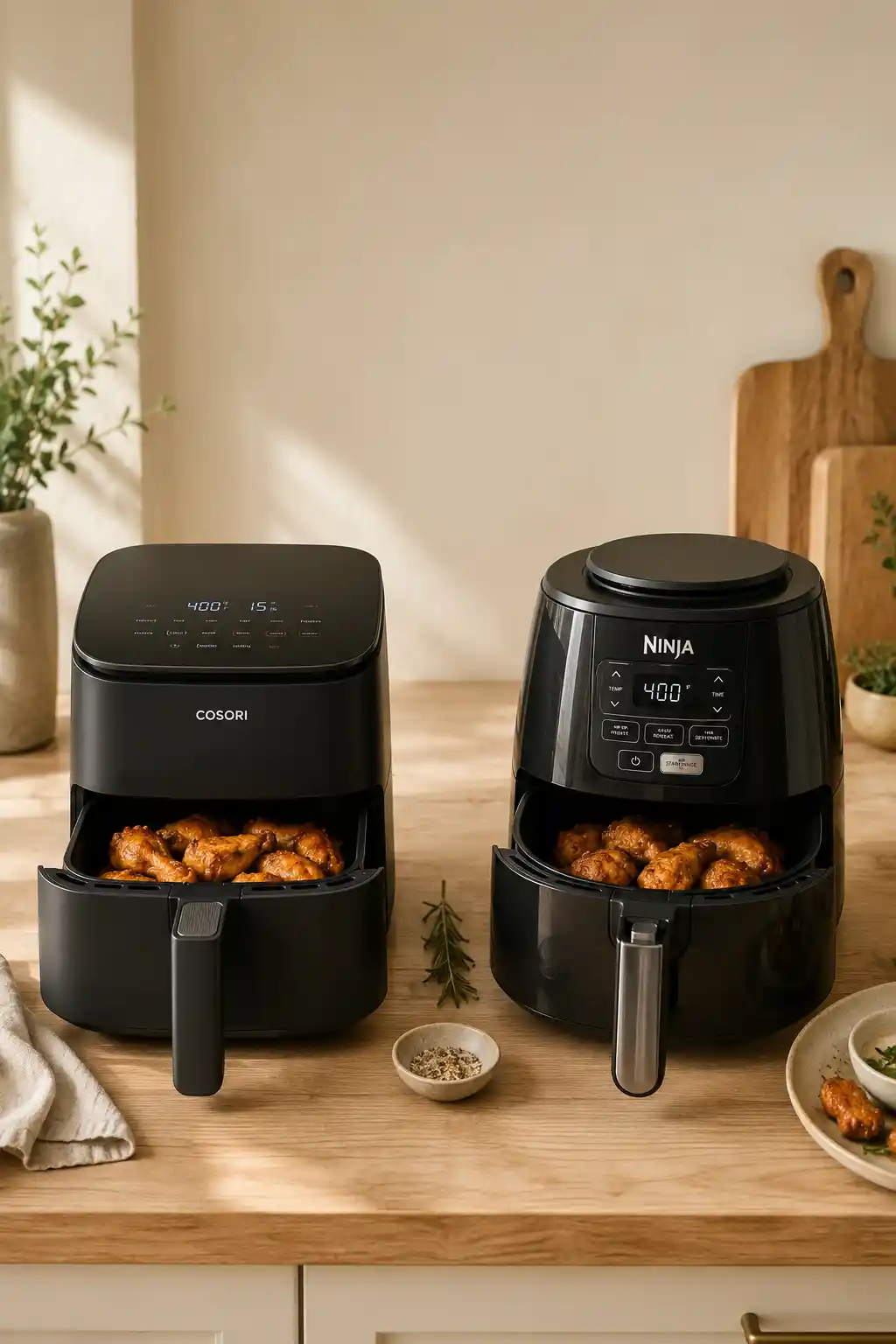
Two of the best-selling air fryer brands, and the choice between them comes down to a few real differences - capacity, noise, basket shape, and how you actually cook. Here's the honest breakdown based on testing data and verified specs.
Ninja and Cosori are the two air fryer brands that show up in almost every "best air fryer" list, and if you've been shopping, you've probably gone back and forth between them more than once.
The good news is that you basically can't go wrong. Both make truly good air fryers. The bad news is that "both are good" isn't helpful when you have to actually pick one. So let me give you the real differences - the ones that matter in daily use, not the ones on the spec sticker.
I pulled together testing data and verified specs from TechGearLab, Consumer Reports' methodology, Homes & Gardens, and several hands-on review sites that cooked the same foods in both brands. Here's how the two actually compare, and which one fits which kind of cook.
The short version
If you cook for one or two people, want quiet operation, and value a wide temperature range with lots of modes, lean Cosori.
If you cook for a family, want to make two foods at once, and don't mind more noise, lean Ninja.
That's the decision in two sentences. Everything below is the reasoning, in case you want to understand why.
The biggest real difference: single basket vs dual basket
This is the one feature that actually separates the two brands, and it might decide your whole choice.
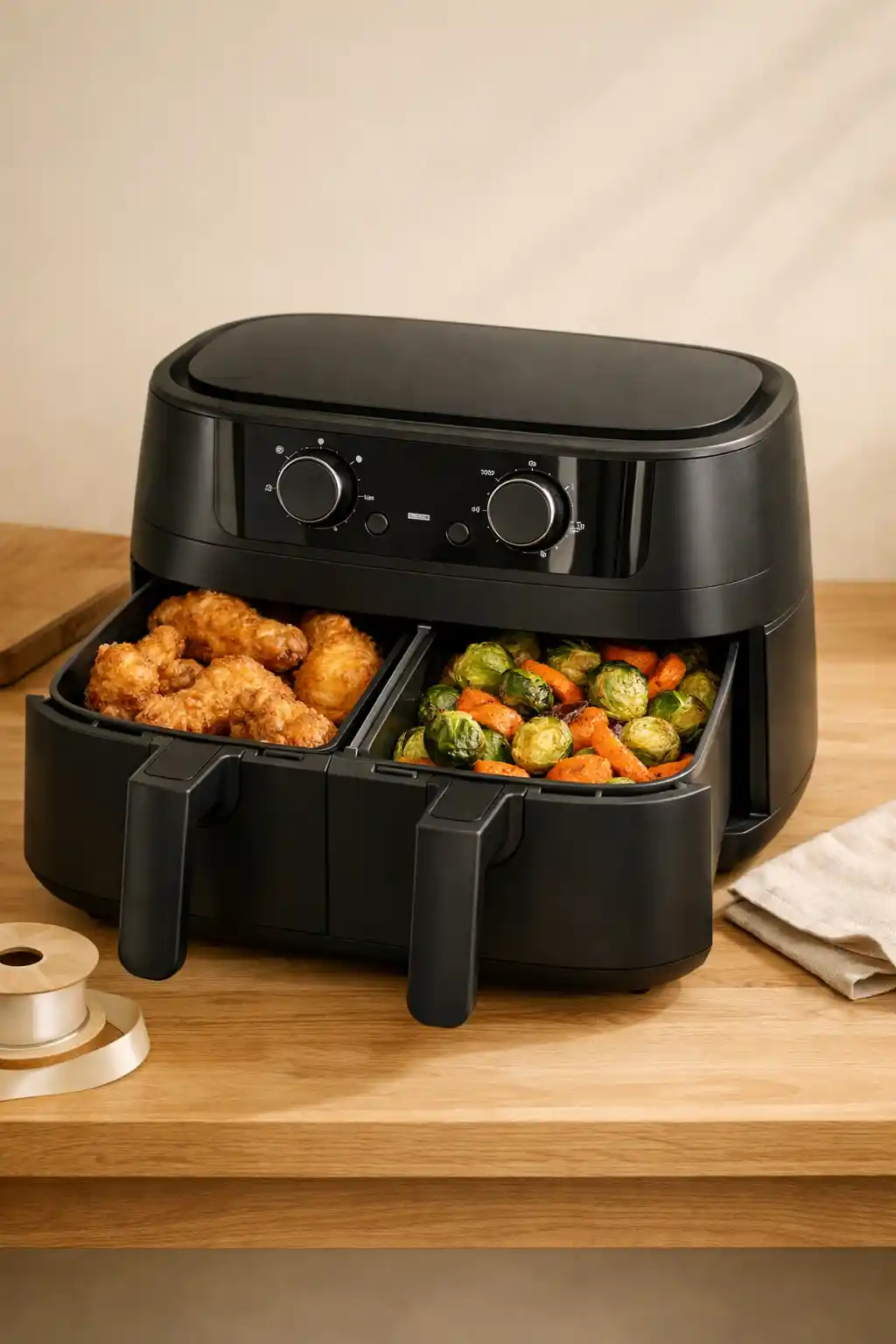
Ninja makes dual-basket air fryers - most notably the Foodi DZ201, which has two separate 4-quart baskets (8 quarts total). You can cook two completely different foods at two different temperatures at the same time. Chicken in one basket, roasted vegetables in the other, both finishing together thanks to a sync function.
Cosori, for the most part, makes single-basket air fryers. One cooking chamber, one temperature at a time.
If you regularly cook complete meals where a main and a side need to finish together, the Ninja dual-basket is genuinely useful in a way no single-basket fryer can match. Multiple reviewers describe it as "having a helper" in the kitchen. For families juggling mains and sides on a weeknight, this is the strongest argument for Ninja.
If you mostly cook one thing at a time, or you're cooking for one or two people, the dual-basket feature is capacity and counter space you're paying for and not using. A single-basket Cosori makes more sense.
This single distinction resolves a lot of the decision. Cook complete multi-dish meals often? Ninja. Cook one thing at a time? Either, with a slight edge to Cosori on the other factors below.
Noise: Cosori wins
This came up across nearly every comparison I read, and it's more significant than people expect before they own one.
Ninja air fryers are louder. The fan has a higher-pitched, more focused sound that's noticeable, especially in a small open kitchen where the cooking area connects to the living space. One tester specifically noted the noise difference was what surprised them most.
Cosori air fryers run quieter. The sound is a lower-frequency hum that fades into background noise more easily. Cosori markets some models with "quiet operation" technology, and independent testers generally confirm it's genuinely quieter than the Ninja equivalent.
Neither brand publishes official decibel ratings, and to be fair, neither is what you'd call silent. Per Consumer Reports' testing methodology, air fryers across all brands fall in the 40-60 dBA range - somewhere between a quiet office and a restaurant conversation. Both Ninja and Cosori land in the upper half of that range. But between the two, Cosori is the quieter choice.
If you have an open-plan kitchen, thin walls, or you cook while someone's watching TV nearby, this matters. If your kitchen is separate and noise doesn't bother you, ignore this factor entirely.
Temperature range and modes: Cosori has more
The Cosori TurboBlaze line runs from 90°F to 450°F, which is a notably wide range. The low end lets you proof dough and dehydrate herbs; the high end (450°F) gives you searing-level heat for charring and maximum crispness.
It also includes more cooking modes - TechGearLab notes the TurboBlaze offers Reheat, Dehydrate, Bake, Proof, and Warm, plus specialized Turbo modes for Air Fry, Roast, Broil, and Frozen foods. The temperature adjusts in 5°F increments for precision.
Ninja's models are a bit more straightforward. The Max Crisp models reach up to 450°F for fast results on frozen food, but the temperature increments are less granular, and there are fewer specialized modes. TechGearLab specifically flagged that the Ninja's temperature gaps are unevenly dispersed, making precise temperature selection harder.
For most everyday cooking - wings, fries, chicken, vegetables - this difference barely registers. For people who like to experiment, proof bread, dehydrate, or want precise temperature control, Cosori's range and granularity are a real advantage.
Cooking power and crispness: a close call, slight edge Ninja for frozen food
Both brands cook well. The difference is subtle.
Ninja air fryers are often described as powerful workhorses. The Max Crisp mode at 450°F is built for rapid, aggressive cooking, which shows up most with frozen foods - fries, wings, tots come out fast and crispy. Ninja's reputation is raw power.
Cosori takes a more balanced-airflow approach, aiming for consistent, even results rather than maximum heat. Testers consistently praise Cosori's results on wings and fries as reliably golden and even. The TurboBlaze series narrowed the power gap significantly compared to older Cosori models.
In head-to-head test cooks, the results came out very close. Where Ninja sometimes pulls ahead is even cooking under heavy loads - though both brands can produce uneven results if you overcrowd the basket and don't shake the food. The honest summary: Ninja edges ahead slightly for frozen-food crispness; Cosori edges ahead slightly for consistency and precision. Neither difference is large.
Basket shape and accessories: Cosori's square basket is more versatile
This is an underrated practical difference.
Cosori's Pro and TurboBlaze models use a square basket. Square baskets fit flat-shaped foods better - sandwiches, pizza slices, fish filets - and the 8-inch square form factor has a wide aftermarket accessory market (silicone liners, cake pans, skewer racks).
Ninja's baskets vary. The AF101 uses an oval/round basket, which limits aftermarket pan compatibility - 7-inch round pans fit, but most square accessories don't.
If you plan to bake in your air fryer (cakes, breads, casseroles) or want to expand with accessories, the Cosori square basket is meaningfully more versatile. If you only ever cook proteins and frozen items, the basket shape barely matters.
Price and value: Cosori usually wins, with one Ninja exception
Cosori models are frequently priced below equivalent Ninja models with similar features. Across multiple comparisons, Cosori is described as the better value pick.
The exception is the Ninja AF101. Per ConvertToAirFryer's April 2026 pricing data, it sits at roughly $99-$109 retail and is described as "the best-priced reliable air fryer we have tested." If you want a no-frills, dependable single-basket fryer at the lowest reliable price point, the AF101 is hard to beat.
For dual-basket capability, Ninja's pricing is higher (the Foodi DZ201 runs significantly more), but there's no direct Cosori equivalent, so it's not really a value comparison - you're paying for a feature Cosori doesn't offer.
The PFAS wrinkle worth knowing about
If non-toxic materials matter to you, there's a detail worth flagging.
Ninja claims its baskets use no PFAS. Cosori markets some models as having "PFAS-free food-contact surfaces." However, TechGearLab reported that when they followed up, the manufacturer indicated PFAS may be present in some Cosori basket coatings despite the marketing language.
This doesn't make either brand dangerous under normal use - PTFE-type coatings are stable at normal cooking temperatures. But if PFAS-free is a genuine priority for you, verify the specific model's current documentation directly rather than trusting the marketing copy on either brand. Our non-toxic air fryer guide covers how to evaluate these claims.
Which specific models to consider
For a couple or small family wanting the best single-basket experience: the Cosori TurboBlaze 6-quart. Wide temperature range, quiet, lots of modes, square basket. TechGearLab's family favorite.
For a family that cooks two dishes at once: the Ninja Foodi DZ201 DualZone. Eight quarts, two baskets, sync finish. The dual-basket capability is the reason to buy it.
For the best budget single-basket fryer: the Ninja AF101. Reliable, well-priced, simple. The value benchmark in the category.
For app features and smart controls: a Cosori model with Wi-Fi and the VeSync app. Ninja is mostly manual-only.
So which should you buy?
Here's the decision, simplified.
Buy Cosori if you cook for one or two people, you want quiet operation, you like having a wide temperature range and lots of cooking modes, you might bake in it, or app features appeal to you. The TurboBlaze is the model most people should look at.
Buy Ninja if you cook for a family and want to make two foods at once (the dual-basket Foodi is the reason), or if you want the most reliable budget single-basket fryer (the AF101). Just be ready for more noise.
For most single-person and couple households, I'd lean Cosori - the quiet operation, temperature range, and value add up. For families who cook complete meals nightly, the Ninja dual-basket is genuinely worth it.
Both are good. This is a low-stakes decision in the sense that you'll be happy with either. It's just a matter of matching the fryer to how you actually cook.
For more on choosing the right size and type, our complete guide to air fryers covers the fundamentals. For specific household sizes, our 2-person air fryer guide goes deeper on matching capacity to how many people you cook for.
Sources and further reading
The information in this article is based on the following sources:
- TechGearLab - "The Best Air Fryers of 2026: Lab Tested & Ranked"
- ConvertToAirFryer - "Ninja vs Cosori Air Fryer: Head-to-Head Comparison"
- Homes & Gardens - "Ninja vs Cosori - who makes the best air fryers?"
- Consumer Reports - Air fryer testing methodology and ratings
Prices and specifications change frequently. Always verify current pricing and specs on the retailer's or manufacturer's website before buying.
Ninja is generally better for families because of its dual-basket models like the Foodi DZ201, which let you cook two foods at different temperatures simultaneously. For single-basket family cooking, the Cosori TurboBlaze 6-quart is also excellent. Both work; Ninja's dual-zone is the differentiator for families who cook mains and sides together.
Cosori is generally quieter. Multiple testers note the Cosori's lower-frequency hum fades into background noise, while the Ninja's higher-pitched fan is more noticeable, especially in small open kitchens. Neither brand publishes official decibel ratings, but the consensus across reviews favors Cosori for quiet operation.
Cosori typically offers better value - comparable models often cost less than equivalent Ninjas with similar features. The Ninja AF101 is the exception, frequently the best-priced reliable single-basket fryer at $99-$109. For dual-basket capability, Ninja's pricing is higher but there's no direct Cosori equivalent.
It's close. Ninja's higher max temperature (450°F on Max Crisp models) gives a slight edge for frozen foods and maximum crispness. Cosori's precise airflow produces consistent golden results on wings and fries. Most testers find the difference small in everyday cooking.
Both have dishwasher-safe baskets. Cosori's square ceramic basket with fewer parts is often rated slightly easier. Ninja's dual-basket models mean cleaning two baskets, which is more work. For single-basket models, the difference is minimal.
It varies by model and the claims require scrutiny. Ninja claims its baskets use no PFAS. Cosori markets some models as having PFAS-free food-contact surfaces, though TechGearLab reported the manufacturer indicated PFAS may be present in some basket coatings. If PFAS-free is a priority, verify the specific model's current documentation directly with the manufacturer.
Both brands are generally praised for 3-4 years of reliable use with regular cooking. Exact warranty terms vary by model - Cosori typically offers a 2-year warranty, Ninja typically 1 year. The fan motor is usually the first component to wear out on either brand.
Get the Cosori TurboBlaze if you want a compact single-basket unit with a wide temperature range (90-450°F), more cooking modes, and quiet operation - ideal for couples and small families. Get the Ninja Foodi DualZone if you regularly cook two different foods at once and need 8-quart capacity for a larger family.
Cosori leads on smart features. Their higher-end models include Wi-Fi and the VeSync app, which can send reminders and adjust fan speeds remotely. Most Ninja models are manual-only. If app connectivity matters to you, Cosori is the better choice; if you never use app features, it's irrelevant.