Table of Contents
AI Summary
Non-Toxic Air Fryers: What PFAS-Free Actually Means (And What to Buy)
Most air fryers are coated with materials people would rather not think about. Here's what PFAS, PTFE, and Teflon actually are, which coating types are genuinely safer, and which brands are transparent enough to trust.
There is a version of this article that tells you everything is fine. Your air fryer is safe, the coatings are stable, stop worrying.
I am not going to write that version.
Not because air fryers are secretly dangerous - they largely aren't, under normal use. But the "PFOA-free" label on most air fryer packaging is doing a lot of work to sound reassuring while technically saying very little. If you have spent time looking into this and feel vaguely misled by the marketing, you are not imagining it.
Here is what the terminology actually means, which coating types are meaningfully safer, and which brands are transparent enough to trust with that claim.
The terminology problem
The label that appears on almost every mainstream air fryer is "PFOA-free." PFOA is a specific chemical that used to be widely used in Teflon manufacturing. It was phased out in the United States by around 2013 after studies linked it to health problems including increased cholesterol, high blood pressure, and certain cancers.
So "PFOA-free" is real. It means something. The problem is that PFAS - per- and polyfluoroalkyl substances - is a family of over 12,000 chemicals, not a single compound. PTFE, the polymer that gives Teflon its non-stick properties, is itself a type of PFAS. Saying a product is "PFOA-free" while still containing PTFE is technically accurate and practically misleading.
Dr. Bruce Jarnot, a board-certified toxicologist with more than 30 years of product safety experience, told Homes and Gardens in 2026: "I'd recommend selecting an air fryer that is PFAS-free." Not just PFOA-free. PFAS-free.
The gap between those two labels is where most mainstream air fryers live.
What PTFE actually does under heat
PTFE is chemically stable under normal cooking temperatures. That is not disputed. The concern comes from what happens when it degrades.
PTFE starts releasing detectable gases somewhere above 500°F. At 570°F, it releases fumes that cause flu-like symptoms in humans - a condition called polymer fume fever. At higher temperatures, the degradation products become more serious. There is documented evidence that pet birds, whose respiratory systems are more sensitive than ours, have died from PTFE fume exposure at cooking temperatures.
Whether your air fryer regularly reaches 500°F depends on the model and what you're cooking. Many air fryers max out at 400°F. Some go to 450°F. A few go higher.
The more practical concern, mentioned across multiple material safety reviews I read, is damaged coating. Scratched, chipped, or peeling PTFE releases particles into food. Non-stick coatings on budget air fryers tend to wear faster - and at that point the theoretical "it's stable under normal temperatures" argument stops applying.
This is not a sky-is-falling situation. It is a reasonable thing to factor into a purchasing decision, especially if you plan to use the appliance daily for several years.
The three safer material types
There are three main alternatives to PTFE-coated baskets. Each has trade-offs.
Ceramic coating is the most common "non-toxic" alternative. It provides non-stick properties without fluoropolymers. A well-made ceramic coating is PFAS-free, PTFE-free, and PFOA-free by nature of what ceramic is.
The caveat is that "ceramic" in marketing doesn't always mean the same thing in manufacturing. Some ceramic coatings contain nanomaterials or metallic compounds that brands don't fully disclose. The Naturally Non-Toxic blog, which contacts manufacturers directly to verify material claims, found that many air fryers marketed as "ceramic" couldn't provide specific answers about the coating chemistry.
Brands that get specific - naming their coating (like GreenPan's Thermolon), confirming it's free of PTFE, PFOA, lead, and cadmium, and explaining what it's applied over - are more trustworthy than brands that just say "ceramic non-stick coating."
Cosori's ceramic-coated models (including the TurboBlaze line) explicitly confirm PFAS-free, PTFE-free, and heavy metal-free status across their product documentation. That level of specificity is worth something.
Stainless steel is the most inert option. No coatings, no fluoropolymers, no ceramic compounds to question. Stainless steel is FDA-approved for food contact, chemically stable at high temperatures, and doesn't degrade in ways that affect food.
The trade-off is cleaning. Stainless steel isn't naturally non-stick, and air-fried food can stick and burn onto stainless surfaces without oil or parchment liners. Some stainless steel air fryers have received consistent complaints about cleanup difficulty. If you are not willing to clean more carefully, stainless steel is frustrating in daily use.
Glass is the safest possible cooking surface - completely inert, no coatings, stable at high heat. The Ninja Crispi uses a glass bowl for the cooking chamber. Fritaire's models use glass throughout.
The practical problems: glass is heavier, more fragile, and limits design flexibility. Glass air fryers tend to cost significantly more than equivalently-sized alternatives. And they're harder to find in the mainstream market.
What to actually look for when buying
The Sustainably Kind Living guide, which I found one of the more rigorous resources on this topic, suggests looking at what food actually contacts rather than what the exterior is made of.
A stainless steel exterior does not mean a stainless steel basket. Read the product page, not the marketing copy.
The claims worth taking seriously are: "PFAS-free," "PTFE-free," and "Teflon-free" applied specifically to the basket and food-contact surfaces. "PFOA-free" alone is not enough.
Red flags: "eco-friendly coating," "advanced non-stick," "healthy ceramic" - any phrasing that describes a coating by what it does rather than what it is. These are phrases that mean nothing specific.
Also worth reading: the user manual, not just the product listing. Some brands bury material disclosures in the manual that don't appear anywhere on the packaging. Cupindy's material safety guide found that brands willing to provide downloadable manuals before purchase are generally more transparent overall.
One more thing that comes up in multiple sources: "PFOA-free" on a product made before 2013 meant something. On a product made in 2026, it means the brand hasn't updated its marketing to a stronger claim. Every mainstream air fryer made today should be PFOA-free. If that's still the headline claim, ask why they can't say more.
The brands that are being specific
Based on my research across Homes and Gardens' 2026 non-toxic air fryer guide (which involved toxicologist consultation), the Naturally Non-Toxic blog's manufacturer-contact process, and Toxic Free Choice's verified roundup:
Our Place Wonder Oven uses PFAS-free ceramic and stainless steel surfaces. Our Place has a strong track record in the non-toxic cookware space and provides specific material disclosures. More expensive than mainstream options but transparent.
Typhur models use PFAS-free, PTFE-free ceramic-coated trays with 304 stainless steel internal components. Multiple sources confirm material claims. Higher price point.
GreenPan (their Elite Convection Oven line) uses Thermolon ceramic coating, confirmed PFAS-free, PFOA-free, lead-free, and cadmium-free. GreenPan's transparency on coating chemistry is better than most.
Cosori TurboBlaze line uses PFAS-free ceramic coating confirmed in product documentation. More accessible price than the above options. Cosori's material transparency has been cited favorably in multiple safety-focused reviews.
GE Appliances offers stainless steel interior models that are PTFE-free, though their included accessories (racks and pans) have received some scrutiny for material composition. Accessible pricing.
Ninja Crispi uses glass bowls, which sidesteps the coating question entirely. More expensive and less widely available.
For most people, the Cosori TurboBlaze ceramic line is the practical entry point - PFAS-free, reasonably priced, and specific enough in its material claims to be trustworthy. For people who want to go further, Our Place or Typhur are the options with the most rigorous transparency.
What about the air fryers you probably already own
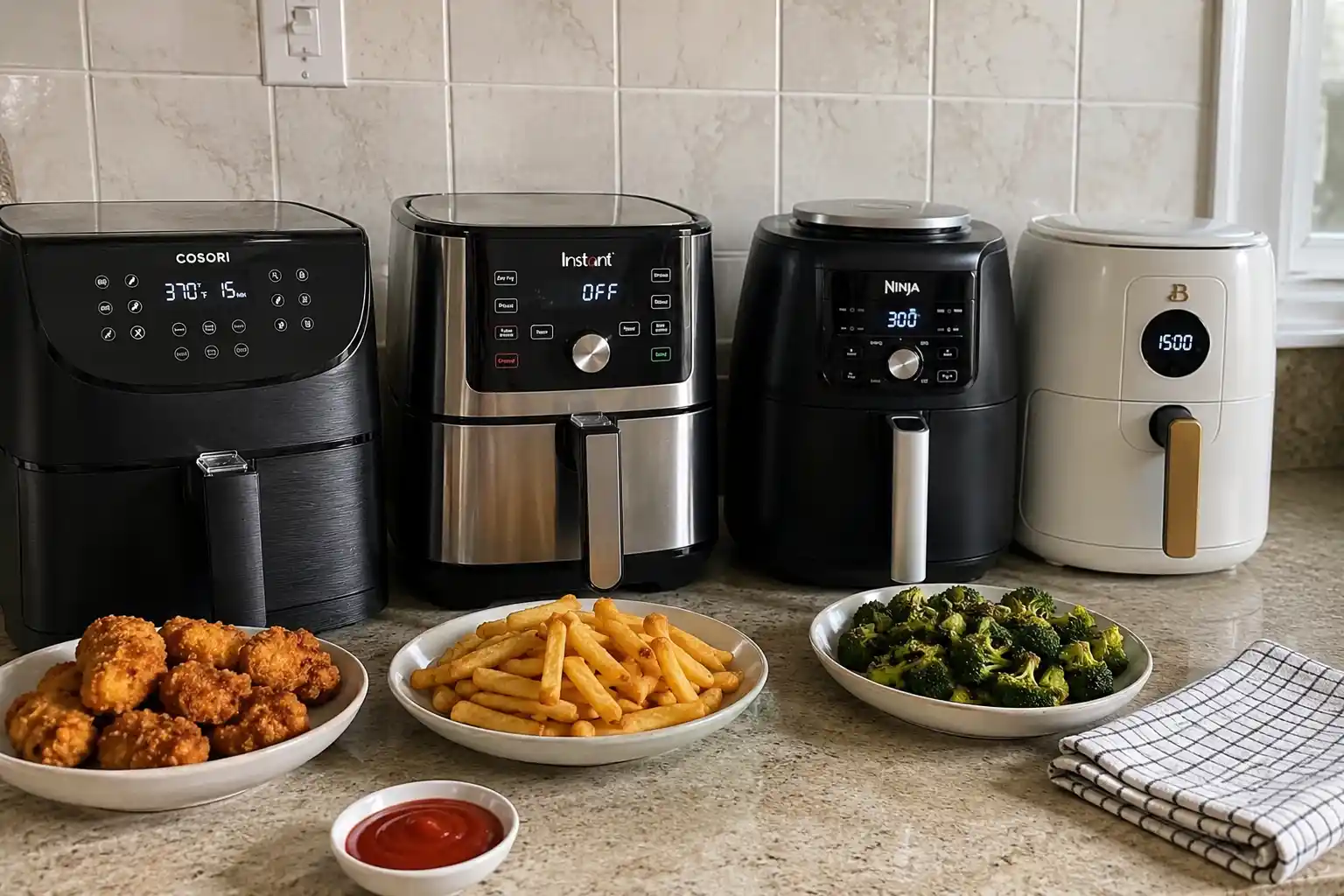
Most mainstream air fryers - Instant Vortex, standard Ninja AF-series, budget Cosori models - use PTFE-based coatings. This doesn't make them dangerous under normal use. It means you should:
Not overheat them. Most go up to 400°F. Don't push past that.
Not use metal utensils in the basket. Scratched PTFE is where the theoretical risk becomes more practical.
Replace the basket, or the fryer, if the coating starts peeling. Chipped PTFE in food is the scenario worth actually avoiding.
Preheat without food in the basket only briefly. Extended empty preheating gets temperatures higher than they'd reach with food present.
None of this is alarmist. It is just treating a non-stick surface the way non-stick surfaces are meant to be treated.
The honest version of the decision
If you are buying a new air fryer and non-toxic materials matter to you: the Cosori TurboBlaze line is the most accessible starting point for verified PFAS-free ceramic. The Our Place Wonder Oven is the premium option with the most transparent materials and a 100-day trial. If you want no coatings at all, the Ninja Crispi's glass bowl is the cleanest solution.
If you already own a mainstream PTFE-coated fryer and you use it sensibly: don't overheat it, don't scratch the basket, replace it if the coating deteriorates. The risk under those conditions is theoretical, not demonstrated.
If you're in a household with infants, people with immune sensitivities, or you just find the ambiguity uncomfortable: the ceramic and stainless steel options exist at reasonable prices and are worth considering.
The market has responded to consumer concern here. The number of genuinely PFAS-free air fryers available in 2026 is much larger than it was three years ago. You don't have to choose between safety and a functional appliance.
For our full breakdown of which air fryers perform best across all criteria, our complete air fryer guide covers what actually matters for everyday cooking.
No. PFOA is one chemical within the PFAS family, which contains over 12,000 compounds. PTFE (Teflon) is itself a PFAS. A product can be PFOA-free and still contain PTFE and other fluoropolymers. Look for "PFAS-free" or "PTFE-free" on the specific cooking surfaces.
Generally yes, but the quality varies. A ceramic coating from a brand that discloses its specific chemistry (PFAS-free, PTFE-free, lead-free, cadmium-free) is meaningfully different from one that just says "ceramic non-stick." Cosori, GreenPan, and Our Place are examples of brands that provide specific disclosures.
Glass is the most inert - no coatings, no fluoropolymers, completely stable at cooking temperatures. Uncoated stainless steel is second. Verified PFAS-free ceramic from a transparent brand is a practical third option.
Not necessarily. Ceramic coatings provide reasonable non-stick performance, though they're generally not quite as slippery as PTFE at equivalent quality levels. Glass and stainless steel require more attention to oiling or lining to prevent sticking.
Not urgently if the coating is intact and you use it at normal temperatures. If the coating is scratched, chipped, or peeling, replace the basket or the unit. Degraded PTFE in food is the scenario worth avoiding.
Parchment liners create a barrier between food and the basket. They don't eliminate exposure to any off-gassing from the walls of the cavity, but they do reduce food contact with the coating surface. Worth using if you have a PTFE basket and you want some reduction in exposure.
Budget brands often manufacture in facilities where the basket coating isn't something they directly specify - it comes with the supplier's standard basket. Brands that specifically source or commission their own basket coatings are the ones that can tell you what's in them.