Table of Contents
AI Summary
Air Fryer vs Microwave: Can One Replace the Other?
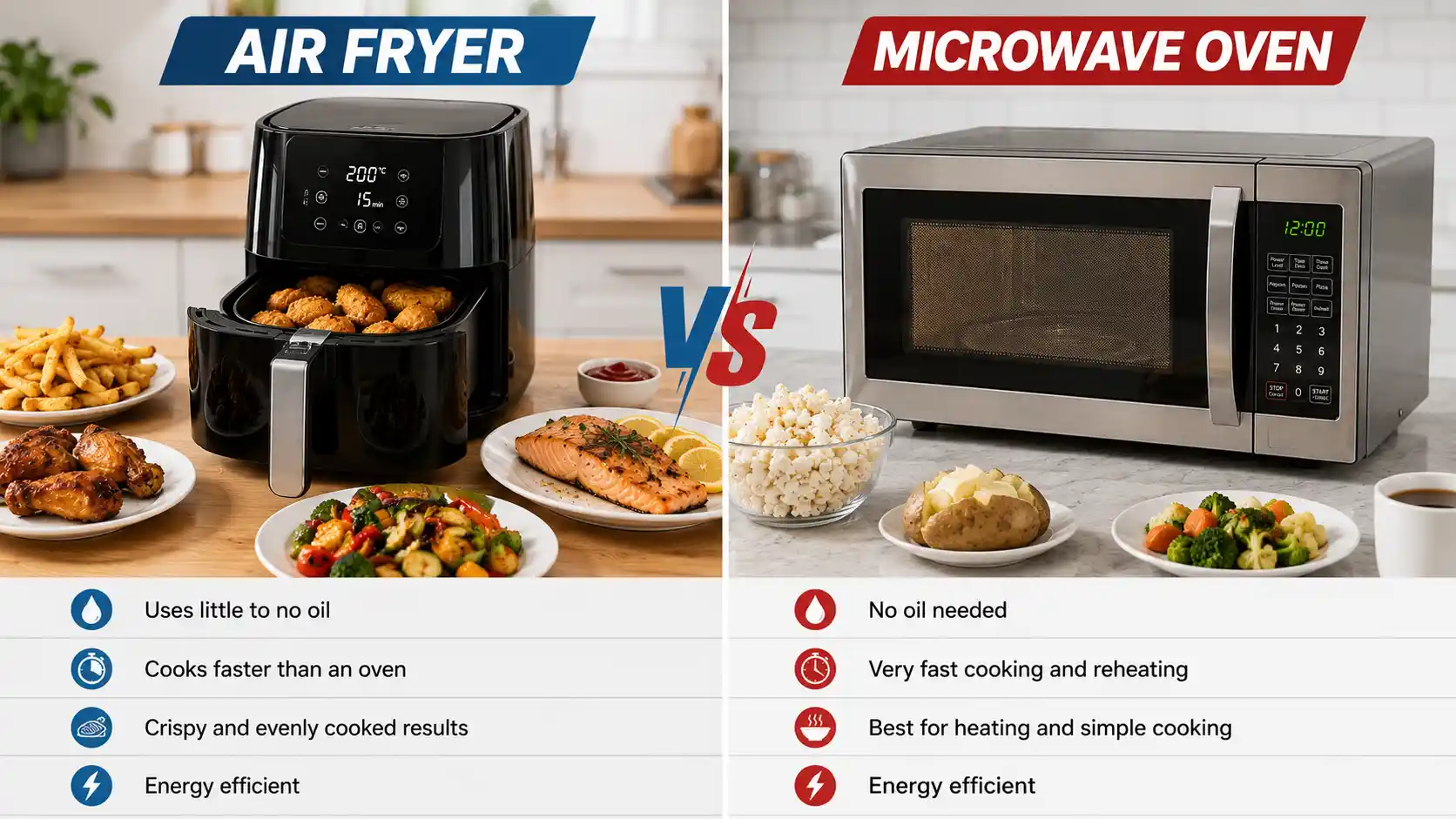
These two appliances both heat food fast, but they do completely different things to it. Here's what each one is actually good at, where they overlap, and whether you really need both on your counter.
People keep asking the wrong question.
The question is not "air fryer or microwave." Those two appliances do almost completely different things to food. Asking which one is better is like asking whether a hammer is better than a screwdriver.
The actual question is whether you need both on your counter, or whether you can get by with one - and which one. That depends completely on how you cook, not on which appliance is more sophisticated.
I went through manufacturer documentation from Whirlpool, KitchenAid, Maytag, and Breville, plus a few hands-on reviews from people who actually replaced their microwave with an air fryer (or considered it). Here is the honest comparison, including the things people don't tell you when they're trying to sell you on one or the other.
What each one actually does
A microwave doesn't cook food the way the rest of your kitchen does. It uses electromagnetic waves to vibrate the water molecules inside food, which generates heat from the inside out. That's why a microwaved potato is hot in the middle but the outside isn't crispy. The heat is coming from within the food itself.
An air fryer does the opposite. It blasts hot air around the outside of food, transferring heat from the surface inward. That's why air-fried things get crispy outside while staying tender inside. The cooking is happening on the surface and working its way in.
This distinction matters because it determines what each appliance is good at.
Microwaves excel at:
- Reheating leftovers fast
- Defrosting frozen food
- Steaming vegetables (with a little water)
- Heating liquids - soups, beverages, sauces
- Making things hot in 60 seconds
Air fryers excel at:
- Crisping the outside of food
- Cooking frozen items so they aren't soggy
- Roasting vegetables and proteins
- Reheating things that were originally crispy (pizza, fried chicken, fries)
- Browning surfaces in a way microwaves cannot
The overlap is small. Both can heat food. Both can technically cook simple things from raw to done. But the experience and result are different in almost every case.
The reheating war
This is where the comparison gets specific, because reheating is where most people use either appliance.
The microwave is faster at reheating. A bowl of soup is hot in 90 seconds. A plate of leftover pasta is ready in about two minutes. There is no replacement for this kind of speed when you're hungry and don't want to wait.
The air fryer is better at reheating. The microwave heats food unevenly - hot spots, cold spots, sometimes a piece of pasta in the middle that's still cold. Worse, microwaves make crispy things sad. Microwaved pizza has a soggy crust. Microwaved fried chicken is rubbery. Microwaved fries are limp and disappointing.
The air fryer takes longer - three to five minutes for most reheating jobs - but the food comes out the way it should be. Pizza crust crisps back up. Fried chicken's coating returns to crunchy. Leftover roasted vegetables get re-roasted. The texture is preserved or even improved.
So which one wins for reheating? The answer is "it depends on the food and how much patience you have."
For things with high water content (soup, sauce, oatmeal, vegetables you want soft), the microwave is faster and the result is fine. For anything that was crispy when you originally cooked it, the air fryer is worth the extra time. Most people who have both develop intuition for which to grab.
What about the texture problem with microwaves?
There is a specific category of food the microwave is genuinely bad at: anything that needs a crispy or browned exterior.
This isn't a limitation that better technique can fix. The microwave's cooking method - heating water molecules from the inside - physically cannot produce browning or crispness. The Maillard reaction (the chemistry that creates browned, flavored crusts on cooked food) requires temperatures above 280°F at the surface of the food, dry conditions, and time. Microwaves run at high power but the surface stays steamy and below the browning threshold because the moisture inside the food is being driven outward.
This is why microwaved chicken is pale and slightly rubbery. Why microwaved fries are limp. Why microwaved bread products are gummy. The microwave can heat them. It cannot transform them texturally the way oven heat or air fryer heat can.
Some convection microwaves attempt to solve this by combining microwave radiation with hot air circulation. These work better than regular microwaves for browning, but most experts I read suggest they don't quite match a dedicated air fryer for crispness, and they don't quite match a dedicated microwave for speed.
The convection microwave is a reasonable compromise. The dedicated tools each do their specific job better.
The case for keeping the microwave
Here is something I want to be honest about. Some content out there pushes the idea of throwing out your microwave entirely once you have an air fryer. I don't think this is good advice for most people.
The microwave still does several things faster than anything else. Heating a cup of coffee that went cold. Melting butter for baking. Defrosting a piece of meat in 5 minutes when you forgot to take it out of the freezer. Steaming frozen broccoli in 4 minutes with a tablespoon of water. Reheating soup, leftovers with a lot of liquid, beverages.
Air fryers cannot do any of these things well. They can technically heat liquid, but slowly, and you'd be running a fan and a heating element to do something the microwave does in 30 seconds with much less energy.
The Ideal Home editor who wrote about replacing her microwave with an air fryer specifically mentioned that she had a "reheat setting" on her air fryer. Even she acknowledged it works "in minutes" - the comparison is to the microwave's seconds. For her London apartment, the counter space tradeoff was worth it. For most kitchens with normal counter space, it isn't.
The case for keeping the air fryer
The air fryer is genuinely transformative for a category of cooking the microwave can't touch.
Reheating pizza so the crust stays crispy. Cooking frozen fries that come out actually crispy instead of soggy. Roasting vegetables in 12 minutes instead of 30. Cooking salmon with a crisp exterior. Reheating fried chicken or breaded foods without ruining them. Making a batch of crispy chickpeas as a snack.
These are real improvements over either a microwave or a traditional oven for these specific tasks. None of them are technically impossible without an air fryer - your oven can do all of this, slower - but the air fryer's combination of speed, small cavity, and strong fan makes it the best tool for these jobs.
If you eat any frozen or formerly-crispy food regularly, an air fryer is worth the counter space.
When you can actually choose just one
If your kitchen is small enough that you genuinely have to choose, the question becomes practical.
Consider keeping just a microwave if:
- You mostly reheat soft foods, soups, and liquids
- You don't eat much fried, breaded, or formerly-crispy food
- You bake most of your other cooking in a regular oven
- Speed matters more than texture for almost everything you make
- You drink a lot of tea or coffee that needs reheating
Consider keeping just an air fryer if:
- You eat a lot of frozen or originally-crispy foods (fries, wings, breaded things, pizza)
- You cook small portions for one or two people
- You don't drink a lot of hot beverages or do a lot of liquid reheating
- The texture of food matters to you more than the seconds saved
- You have an oven for baking and don't need a microwave's specific cooking abilities
For most people, the honest answer is to keep both if there's space. The combined function is more useful than either alone. They're not redundant - they're complementary.
The combo appliance question
In the last few years, several manufacturers have released "convection microwaves" or "microwave-air fryer combos" that try to do both jobs in one appliance. KitchenAid, Whirlpool, Maytag, and others all have versions.
These are reasonable compromises if counter space is the limiting factor. The microwave portion works like a normal microwave. The air fry mode runs as a high-powered convection cycle that produces decent crisping.
The trade-offs:
The air fry results aren't quite as crispy as a dedicated basket air fryer. The cavity is bigger, the fan is less concentrated, and the cooking surface (a metal rack) doesn't drip oil away the way an air fryer basket does. Food gets crispy. It just doesn't get quite as crispy.
The microwave results are usually fine. Convection microwaves work well as microwaves.
The combined unit is more expensive than buying a basic microwave plus a basic air fryer separately, but it takes up less counter space. For studio apartments, RVs, or kitchens where space is genuinely the constraint, the combo unit makes practical sense.
For everyone else, two separate appliances usually delivers better results in each function.
Energy use, since people ask
Microwaves are generally more energy-efficient than air fryers per unit of food.
This is because microwaves directly heat the food's water molecules without heating the surrounding cavity much. Air fryers heat the cavity, which then heats the food - there's energy lost to heating air that doesn't end up in your meal.
In practice, the difference matters more for some uses than others. For reheating a small bowl of soup, the microwave uses meaningfully less electricity. For cooking a tray of vegetables, the air fryer is comparable to a regular oven (which is what you'd be using if you didn't have the air fryer) and significantly more efficient than that, even if not as efficient as the microwave for the same task.
If energy efficiency is a priority, the microwave wins on the things microwaves do well. The air fryer wins compared to using a regular oven for the things air fryers do well.
What I'd actually do
Here's my honest take.
If you have counter space and budget for both: keep both. They're not redundant. The microwave handles the fast small things. The air fryer handles the texture-dependent things. Together they cover almost every quick-cooking situation.
If you have to pick one and you cook primarily for one or two people, eat a fair amount of frozen or formerly-crispy food, and have a regular oven for everything else: the air fryer is more useful.
If you have to pick one and you mostly reheat leftovers, drink hot beverages constantly, cook from scratch in a regular oven, and don't care much about food texture for quick meals: the microwave is more useful.
If you genuinely can't have both and want to do everything an air fryer plus microwave does: the convection microwave with air fry mode is the practical solution. It compromises a little on each function but takes up half the counter space.
For more on whether you actually need an air fryer in the first place, our complete guide to air fryers covers what these appliances are actually good for. For comparing air fryers to traditional ovens, our convection oven comparison goes deeper on that question.
For most kitchens, no. Microwaves are dramatically faster at reheating liquids, defrosting, and any task involving high-moisture foods. Air fryers can technically heat food, but they're slower for the things microwaves do best. They cover different needs.
Because air fryers can produce browning and crisping, which microwaves physically cannot. The Maillard reaction (the chemistry behind browned crusts) requires high surface temperatures and dry conditions - microwaves don't deliver either.
No. Microwaves are generally more energy-efficient per unit of food because they heat the food directly rather than heating the cavity around it. Air fryers are more efficient than ovens but less efficient than microwaves for the same task.
Yes, if counter space is the limiting factor. They handle microwave tasks well and air fry tasks reasonably well. Dedicated appliances each do their specific job better, but combo units are a practical solution for tight kitchens.
Because the microwave heats the moisture in the dough from the inside, which creates steam, which makes the crust soggy. The microwave cannot brown or crisp the surface. An air fryer reverses this - the dry hot air around the pizza re-crisps the crust while warming the toppings.
For most people in normal-sized kitchens, two separate appliances work better. Combo units make sense for tight kitchens, RVs, or anyone whose primary constraint is counter space.
Both can cook frozen food, but the results differ. Microwaves heat frozen food quickly but the texture suffers - frozen pizza in a microwave is unpleasant. Air fryers cook frozen food more slowly but preserve or improve the texture significantly. Frozen fries, wings, and similar foods are dramatically better in an air fryer.
Microwave radiation is non-ionizing, which means it doesn't damage cellular DNA the way X-rays or UV radiation can. The radiation is contained inside a metal-shielded cavity during operation. There's no credible scientific evidence linking proper microwave use to health problems.