Table of Contents
AI Summary
Air Fryer vs Convection Oven: What's the Real Difference (And Which Do You Actually Need)?
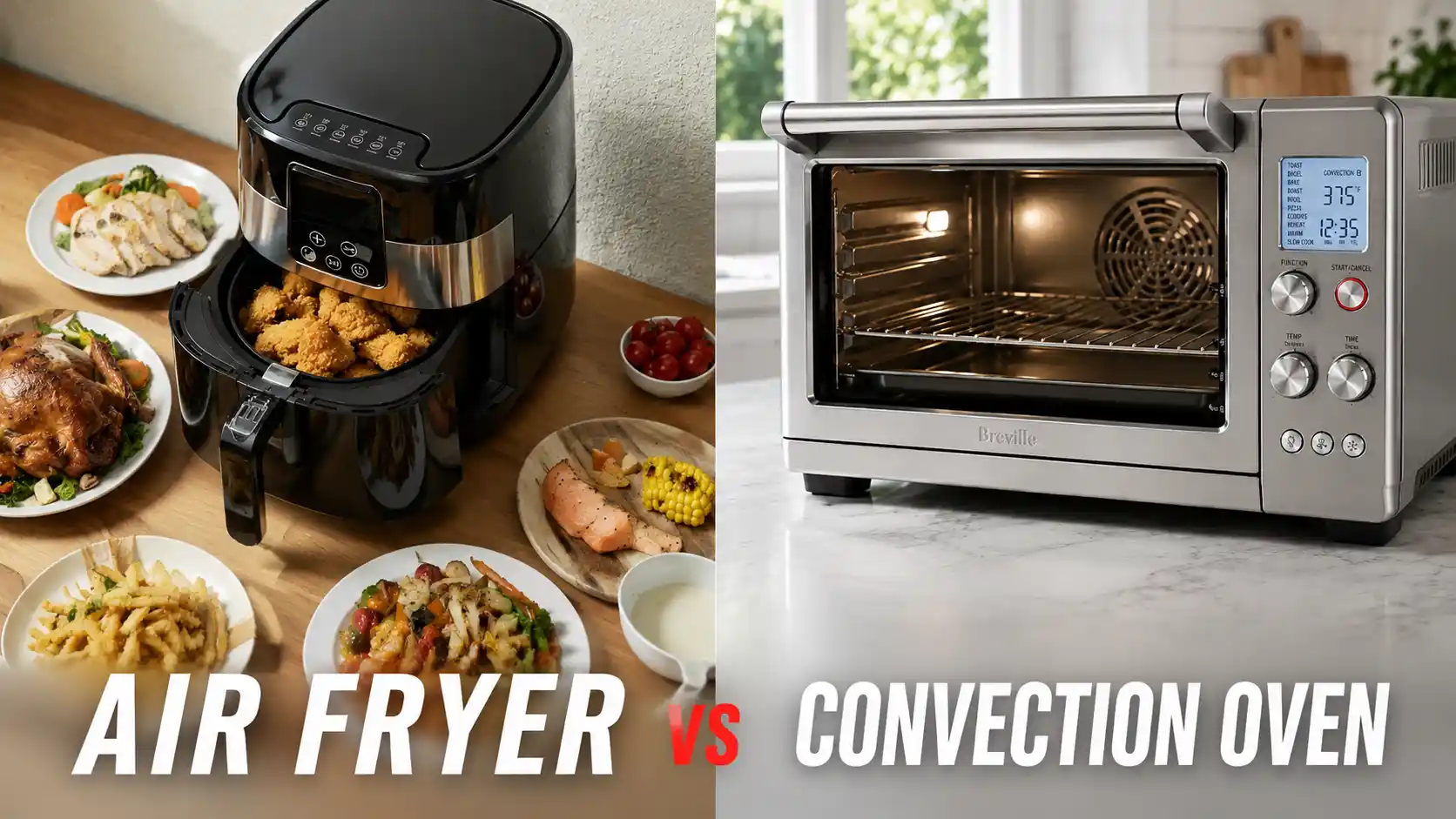
These two appliances do basically the same thing - circulate hot air around food. But the differences in size, intensity, and what you'll actually use them for matter more than the marketing suggests.
Here is the secret nobody tells you when you're shopping for an air fryer.
An air fryer is a convection oven. That's it. That's the whole technology. A heating element plus a fan that pushes hot air around food, faster than a regular oven, in a smaller cavity.
The marketing has done a remarkable job convincing people these are two completely different appliances. They are not. But they're also not interchangeable, and the differences that exist actually matter when you're trying to decide which one (or both) belongs in your kitchen.
I went through about a dozen comparison guides from manufacturer sites (Whirlpool, Maytag, Frigidaire, Breville) and reading forums where people actually argued about this for hours. Here is what I think is the honest version of this comparison.
The thing they have in common
Both appliances cook food by circulating hot air around it. A heating element produces heat. A fan moves the heat. The moving air transfers more energy to the food's surface than still air does, which is why convection cooking gets things crispy and browns them better than a traditional oven.
This is the same basic mechanism in both. If someone tells you an air fryer "fries" food using some special technology, they're either confused or selling something. There is no oil. There is no actual frying. It's hot air, moving fast.
The differences are in how that mechanism is implemented.
Is an Air Fryer Just a Convection Oven?
Short answer: yes. The question "is an air fryer a convection oven" comes up constantly, and the honest answer is that an air fryer is a convection oven - just a small, intense one. Same heating element, same fan, same hot air moving around your food. If you stripped the labels off and looked at the engineering, you'd have a hard time arguing they're fundamentally different machines. So when people ask whether the two are the same, the technically correct answer is that they share the exact same cooking method.
Where the "are they the same" question gets a little more nuanced is in the implementation. An air fryer packs that convection mechanism into a much smaller cavity with a fan that's stronger relative to its size, which is why it crisps food faster and more aggressively than a full-size convection oven. So they're the same technology doing the same thing - but the size and fan power mean they don't always produce identical results. Same category, different intensity.
What makes an air fryer different
The cavity is small. That is the most important fact about air fryers, and it explains most of the other differences.
A convection oven cavity is large - somewhere between 4 and 6 cubic feet for a full-size oven. An air fryer cavity is usually between 4 and 8 quarts, which works out to a fraction of that volume. When you push the same amount of heat into a smaller space, the heat transfers to food more aggressively.
The fan is also stronger relative to the cavity size. Frigidaire's documentation says their air fry settings use convection elements "more than twice as powerful as a standard convection element." That is the appliance specifically designed to replicate frying-style intensity.
Air fryers also tend to vent food differently. Most basket-style air fryers cook from the top down - the heating element is above the food, with the fan pushing hot air down through a perforated basket. The basket holes let oil and grease drip away from the food, which contributes to the "fried" texture without the actual oil.
So the real differences come down to:
Heat intensity is higher in an air fryer because the cavity is smaller.
Airflow is more concentrated because the fan is closer to the food.
Preheat time is shorter because there's less air to heat up.
The result is more crisping, faster, on a smaller batch of food.
What makes a convection oven different
Convection ovens come in two forms - built-in (the oven in your kitchen) or countertop (similar to a toaster oven, just with a fan). Both are larger than air fryers.
The advantage of size is real. You can roast a whole chicken, a sheet of cookies, multiple pans of vegetables, or a casserole - none of which fit in an air fryer. If you cook for more than two people regularly, this matters constantly.
Convection ovens also cook more gently. The fan circulates air at lower velocities, which is better for delicate foods. Pastries, custards, anything where you don't want the surface blasted into crispness - these work better in a convection oven than in an air fryer.
Most convection ovens also offer multiple cooking modes - bake, broil, roast, sometimes air fry. Air fryers usually offer one cooking mode (air fry) plus a few preset programs that adjust time and temperature for specific foods.
The trade-off is that convection ovens take longer to preheat, use more energy, and don't get food quite as crispy as a dedicated air fryer.
Where the marketing gets confusing
Here is where things start to overlap and the lines blur.
Many newer ovens have an "Air Fry" mode. This is a convection oven setting where the fan runs faster and the temperature climbs faster, designed to mimic what a countertop air fryer does. Some of these work really well. Some are just regular convection cooking with a different label.
Whirlpool's air fry setting in their built-in ranges, for example, comes with a perforated air fry basket that lets oil drip away - which is the actual mechanism that makes basket air fryers work. With that basket, the oven is closer to a real air fryer. Without it, you're just doing convection cooking on a sheet pan.
Frigidaire's documentation acknowledges this directly. They specifically built a more powerful convection element for their air fry mode, because regular convection alone isn't quite the same.
Then there's the appliance category that doesn't help - countertop convection ovens with air fry settings (sometimes called "air fryer toaster ovens"). These are convection ovens shaped like toaster ovens, with a fan and an air fry mode. They're roughly halfway between a basket air fryer and a traditional convection oven.
Why Do They Call It an Air Fryer If It's a Convection Oven?
If the technology is just convection, why do they call it an air fryer at all? The answer is marketing, not engineering. "Convection oven" had been around for decades and sounded like a boring, expensive appliance most people associated with professional kitchens. When the compact basket-style versions hit the consumer market in the 2010s, manufacturers needed a name that sold the result - crispy, fried-style food without a vat of oil - rather than the mechanism. "Air fryer" did exactly that. It promised the texture of deep frying with the implication that air was doing the work, and it caught on fast.
The name stuck because it described what people actually wanted, even though no frying happens inside one. There's no oil bath, no submerging, none of the chemistry that defines actual frying - it's the same hot circulating air a convection oven uses, just concentrated. Calling it a "small high-powered convection oven" would have been more accurate and far less appealing. So the term "air fryer" won out as a branding decision, and now we're stuck with a name that describes the food it makes rather than the technology inside it.
The actual question: which do you need?
Forget the technology comparison for a minute. The decision comes down to how you cook.
You probably want a basket air fryer if:
You cook for one or two people most of the time. The smaller cavity is right for that quantity of food.
You want the most crispy, fried-style results. The smaller cavity and stronger fan deliver that better than even a great convection oven.
Counter space is tight. Air fryers are smaller than countertop convection ovens by a meaningful margin.
You mostly heat up frozen food, reheat leftovers, or cook simple proteins. Air fryers handle these tasks faster than ovens.
You don't bake. If your cooking pattern doesn't include cookies, breads, casseroles, or baked goods, you don't need oven capabilities.
You probably want a convection oven if:
You cook for three or more people regularly, or you entertain. The capacity matters more often than you'd think.
You bake. Cakes, breads, large batches of cookies, casseroles - these need oven space and gentler convection.
You already have a regular oven that's broken or outdated, and replacing it with a convection model gets you both regular oven function and convection in one appliance.
You want one appliance that does many things. Convection ovens can bake, broil, roast, and (with the right model) air fry.
You probably want both if:
You cook for a family but also frequently make small meals for one or two. The convection oven handles the big jobs, the air fryer handles the quick small ones.
You bake regularly but also want fast crisping for weeknight dinners. Different appliances for different cooking styles.
You have the counter space to leave them both out. This is the biggest practical limit on owning both.
The kitchen appliance with air fry feature option
The third path - buying a range or oven that has both convection and air fry built in - is increasingly common in 2026.
These work reasonably well for most people. The air fry mode in modern ranges is genuinely effective for things like fries, wings, and roasted vegetables. You don't need a separate countertop appliance taking up space.
The trade-off: built-in air fry modes don't quite match the intensity of a dedicated basket air fryer. The cavity is bigger, the fan is less concentrated, and the cooking surface (a perforated basket if you have one, otherwise a baking sheet) doesn't drip oil away as effectively. The food gets crispy. It just doesn't get quite as crispy as a basket air fryer would deliver.
For most people this is a perfectly acceptable compromise. For people who really care about achieving the deep-fried texture without oil, the basket air fryer still wins.
The cleanup question, since people always ask
Air fryer cleanup is genuinely easier than convection oven cleanup, mostly because there's less surface area.
A basket-style air fryer has one part to wash - the basket - and that part is usually dishwasher safe. Most people throw it in the dishwasher between uses. The cavity stays mostly clean because grease drips into the basket below.
A convection oven has racks, walls, and a floor that all collect grease over time. Manufacturer guidance generally suggests deep cleaning every three months or so. The wider the surface area, the longer the cleaning takes.
If cleaning frustration is a major factor in whether you'll actually use your appliance, this favors the air fryer.
A note on cooking time and temperature
Both appliances cook faster than a traditional oven, but the math isn't identical.
Air fryers and convection ovens both work at roughly 20 to 25 degrees lower than a conventional oven would for the same recipe. So a recipe calling for 400°F in a regular oven would be 375°F in either a convection oven or air fryer.
Cooking times are slightly shorter in both versus a regular oven. Air fryers tend to be slightly faster than convection ovens because of the smaller cavity, but the difference is usually a couple of minutes, not dramatic.
If you're converting a recipe from regular oven to either appliance, the rule is: drop the temperature 25 degrees, reduce cooking time by about 20 percent, and check earlier than you'd expect to.
Air Fryer vs Convection Oven: Cooking Times
When people compare air fryer vs convection oven cooking times directly, the rough rule is that an air fryer cooks about 20 percent faster than a convection oven for the same food. The reason is the same one that explains everything else about air fryers - the smaller cavity concentrates the heat, so food hits its target temperature sooner and the surface browns faster. The convection oven gets there too, just with a bigger space to heat and slightly less aggressive airflow.
Here's roughly how that plays out on common foods, assuming similar batch sizes:
Frozen fries: about 12-15 minutes at 400°F in an air fryer, versus 18-22 minutes in a convection oven. The air fryer's edge is most obvious here because crisping is exactly what it's built for.
Bone-in chicken thighs: about 18-22 minutes in an air fryer, versus 25-30 minutes in a convection oven. The air fryer renders the skin crispier in less time, though the convection oven handles a larger batch in one go.
Roasted vegetables (broccoli, brussels sprouts, peppers): about 10-14 minutes in an air fryer, versus 15-20 minutes in a convection oven. Again, roughly a 20 percent time saving in the air fryer.
Two caveats keep this from being a clean win. First, the air fryer's speed assumes a single layer of food - overcrowd the basket and the times stretch out fast. Second, that smaller cavity means large quantities have to be cooked in batches, so the convection oven often finishes a big meal sooner overall even though it's slower per tray. For one or two portions the air fryer is genuinely faster start to finish. For a crowd, the convection oven's capacity usually wins back the time.
What I'd actually do
If I had unlimited counter space and budget, I'd own a basket air fryer for quick weeknight cooking and a quality convection oven for everything else.
If I had to pick one and I cook for one or two people, I'd pick a basket air fryer. The frequent use cases (quick meals, reheating, getting frozen things crispy) come up more often than baking cookies does for most households.
If I had to pick one and I cook for a family, I'd pick a convection oven - ideally a built-in range with an air fry mode. The capacity matters too often to give up.
If I'm replacing a broken regular oven, I'd absolutely get one with convection plus air fry. The cost premium over a basic oven is small. The flexibility is worth it.
For more on what makes a good air fryer in the first place, our complete guide to air fryers covers what these appliances actually do well. For specific buying advice on basket air fryers, our small-apartment guide and budget guide cover the major picks.
Functionally, yes. Both use a heating element and a fan to circulate hot air around food. The differences come from cavity size, fan power, and design choices, not the underlying cooking method.
The smaller cavity concentrates the heat, the fan is closer to the food, and most basket air fryers let oil drip away from the food during cooking. All three of these contribute to a crispier result than a convection oven of similar quality.
For most cooking, yes. For maximum crispness on foods like fries and wings, a dedicated basket air fryer is still slightly better. The gap is small enough that most people don't notice.
You don't need both. Most households would be fine with either one. Both makes sense if you cook for varied quantities (sometimes one person, sometimes a crowd) and have the counter space.
A convection oven with both regular and convection modes can absolutely replace a regular oven. Most modern ovens with convection let you choose the mode for each recipe.
Air fryers preheat in about 2-5 minutes because of the small cavity. Most convection ovens preheat in 10-15 minutes. If preheating speed matters to you (it does for weeknight cooking), this is one of the most consistent advantages of an air fryer.
Per cooking session, the air fryer almost always uses less electricity because it cooks faster and the cavity is smaller. Per amount of food cooked, the math gets closer because the air fryer requires more cycles to cook the same quantity. For typical small-meal cooking, the air fryer wins on energy use.
Mostly yes. Recipes designed for a convection oven work in an air fryer at the same temperature, just with shorter cooking times and smaller batches. Recipes designed for a regular oven need adjustment in either appliance - drop the temperature 25 degrees and reduce cooking time by about 20 percent.
Technically, yes - an air fryer is a small convection oven. Both use a heating element and a fan to circulate hot air around food. The differences come from the air fryer's smaller cavity and stronger, more concentrated airflow, which crisp food faster. The underlying cooking method is the same.
"Air fryer" is a marketing name, not a separate technology. It stuck because it describes the result people want - fried-style crispness without oil - better than "small convection oven" does. The name sells the texture, not the mechanism, which is why the same convection technology gets two very different labels.
Usually yes - an air fryer typically cooks about 20 percent faster than a convection oven because its smaller cavity concentrates the heat and preheats almost instantly. For a batch of fries or wings that might mean a few minutes saved, though for large quantities the air fryer's smaller capacity means cooking in multiple rounds.