Table of Contents
AI Summary
Can Air Fryers Cause Cancer? The Honest Answer From Actual Research
There are real reasons people are asking this question, and there are real answers. Here's what the science actually says about acrylamide, nonstick coating fumes, and whether your air fryer is a problem.
The short answer is no.
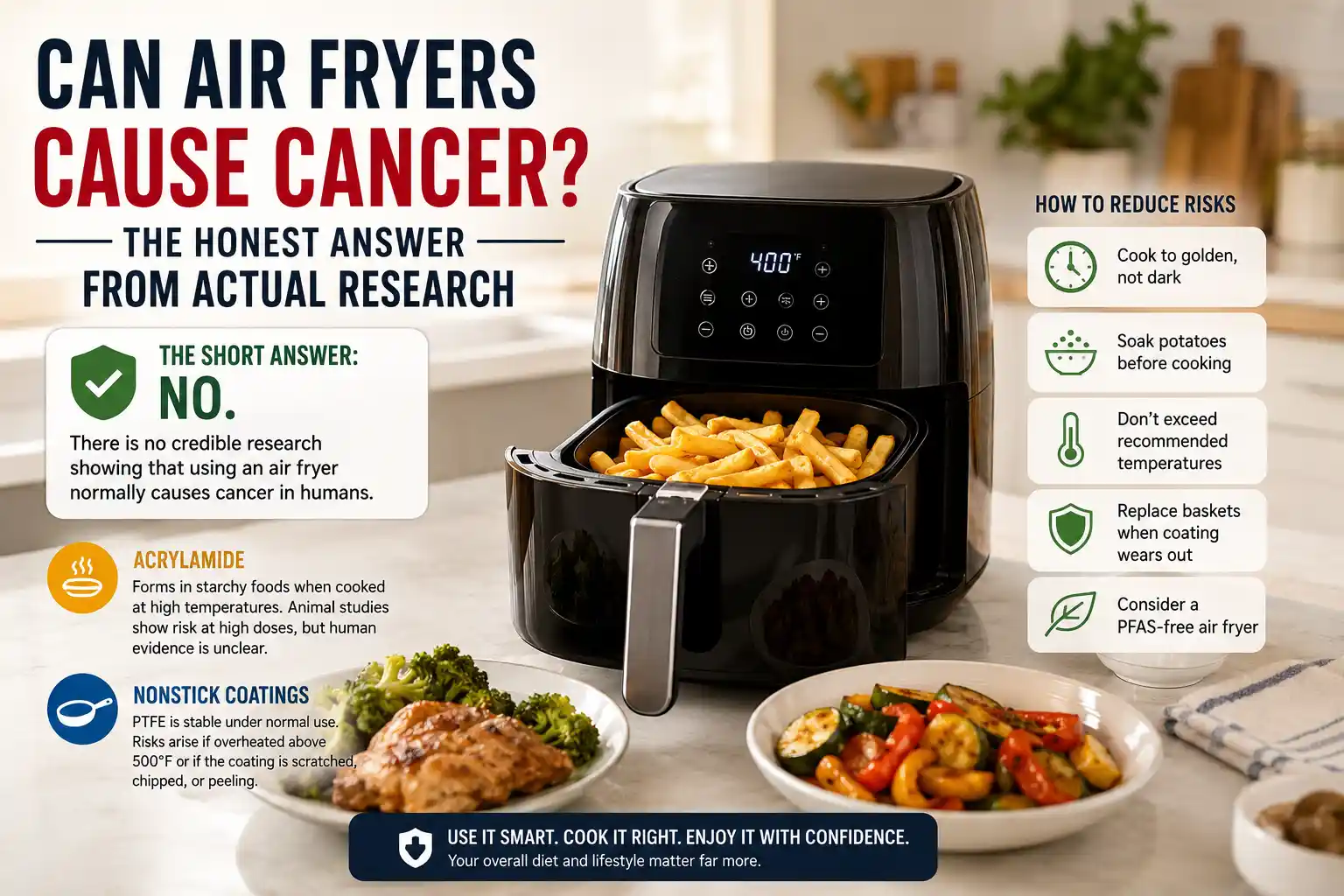
There is no credible research showing that using an air fryer normally causes cancer in humans. If you came here worried, you can stop worrying. Your appliance is not giving you cancer.
The longer answer is more interesting, because the question doesn't come from nowhere. There are two specific concerns that have circulated in social media, news articles, and viral TikToks that gave this question its life. Both have a kernel of truth. Both have been blown out of proportion. And understanding what the actual research says is more useful than either dismissing the worry or panicking about it.
I went through papers from the FDA, the National Cancer Institute, peer-reviewed studies in nutrition journals, and Poison Control's official guidance. Here is what is actually true about air fryers and cancer risk.
The first concern: acrylamide
Acrylamide is the chemical that gets mentioned in every "is your air fryer killing you" article. Here is what it actually is.
Acrylamide forms naturally in starchy foods when they're cooked at high temperatures. Potatoes, bread, cereals, coffee beans - anything with starch and a certain amino acid called asparagine produces acrylamide when heated above about 248°F (120°C). It's a byproduct of the Maillard reaction, which is the same chemistry that makes browned food taste good.
Why people care: high doses of acrylamide cause cancer in lab animals. The International Agency for Research on Cancer classifies it as Group 2A - "probably carcinogenic to humans" - based mainly on this animal research. The FDA and other health agencies have flagged it as a potential concern.
Why this is more nuanced than it sounds: the doses given to lab animals are much higher than what humans get from food. The human research is much less clear. Multiple epidemiological studies looking at dietary acrylamide and cancer rates in actual people have not found consistent strong links. Poison Control's official position, citing the National Cancer Institute, is that "a clear relationship between dietary acrylamide intake and cancer has not been established" in humans.
So acrylamide is real. The animal evidence is real. The question of how much it matters for human cancer risk from normal eating is genuinely uncertain, and most reasonable health experts treat it as a "probably worth minimizing" rather than "actively dangerous" issue.
What air fryers specifically have to do with this
Here is where it gets interesting, because the research has gone in different directions.
A 2020 study found that air frying produced less acrylamide than deep frying when cooking chicken - and less of another set of compounds called polycyclic aromatic hydrocarbons (PAHs), which are also concerning. That research suggested air frying might actually be a healthier high-heat cooking method.
A 2024 study published in Frontiers in Nutrition found the opposite for potatoes. Researchers at Gazi University tested air-fried, deep-fried, and oven-fried potatoes and found that air-fried potatoes contained slightly more acrylamide (12.19 ± 7.03 μg/kg) than the other methods.
So which is it? It depends on the food, the temperature, and the cooking time. Air fryers can produce more or less acrylamide than other methods depending on what you're cooking. The differences are not huge in either direction.
The same 2024 study found something more practically useful: pre-soaking the potatoes before cooking reduced acrylamide formation across all three cooking methods. The cooking method matters less than how brown you let your food get and what you do before cooking.
What the FDA actually recommends
The FDA's guidance on acrylamide is straightforward and applies to any high-heat cooking method:
Don't over-brown your food. The darker it gets, the more acrylamide it contains. Pulling food out at golden brown rather than dark brown reduces acrylamide significantly.
Soak potatoes before cooking. Soaking raw cut potatoes in water for 15-30 minutes before cooking reduces acrylamide formation. This works for fries, hash browns, anything starchy.
Store potatoes properly. Refrigerator-stored potatoes produce more acrylamide when cooked than potatoes stored at room temperature. Keep them in a cool, dark cabinet, not the fridge.
Don't toast bread to dark brown. Same principle. Lightly toasted bread has less acrylamide than dark-toasted bread.
These are recommendations for any cooking method, not specifically for air fryers. The FDA does not have any special guidance for air fryers because the appliance itself is not the issue - high-heat cooking is the issue.
The second concern: nonstick coating fumes
This is the other thing people worry about, and it has a different kind of truth to it.
Most mainstream air fryers have baskets coated with PTFE (the chemical name for what's sold as Teflon). Under normal cooking temperatures, PTFE is chemically stable. Above about 500°F, it starts releasing detectable gases. At higher temperatures, those gases can cause flu-like symptoms in humans (a condition called polymer fume fever) and can be fatal to pet birds, whose respiratory systems are very sensitive.
Most air fryers max out at 400°F. Some go to 450°F. A few specialty models go higher. Under normal use, you should not be reaching the temperatures where PTFE significantly degrades.
The more practical concern is damaged coating. Scratched, chipped, or peeling PTFE releases particles into food. The "stable under normal use" argument doesn't apply once the coating itself is breaking down.
Whether PTFE specifically causes cancer in humans is unsettled. PFOA, an older chemical that used to be part of Teflon manufacturing, was linked to cancer and was phased out of US production by 2013. PTFE itself is not classified as a carcinogen by IARC or the EPA. But PFAS chemicals as a broader class have been linked to various health concerns including some cancers, and PTFE is technically a type of PFAS.
The honest summary: PTFE air fryers under normal use are probably fine. PTFE air fryers with damaged coatings are not. If your basket is scratched or peeling, replace it or replace the appliance.
For people who want to avoid the question entirely, there are PFAS-free air fryers using ceramic, stainless steel, or glass cooking surfaces. Our non-toxic air fryer guide covers which brands are transparent enough to actually trust on these claims.
What about the Prop 65 warning labels?
If you've seen an air fryer with a "this product contains chemicals known to the State of California to cause cancer" label, you might have wondered what that means.
Proposition 65 is a California law requiring warning labels on products that contain any of about 900 listed chemicals at levels above specific thresholds. The list includes things like lead, certain plastics, some flame retardants, and various manufacturing residues.
A Prop 65 warning on an air fryer typically means the manufacturer is being cautious about a small amount of some listed chemical somewhere in the product - usually in the cord, the casing, or some component, not in the cooking surface itself. The thresholds for triggering the warning are intentionally very low to capture any potential exposure.
A viral TikTok in 2023 claimed Prop 65 warnings on air fryers proved they cause cancer. Fact-checkers from Verify and Poison Control debunked this. The warning is a labeling requirement under a state law, not a determination that the product causes cancer when used normally.
This doesn't mean Prop 65 warnings should be ignored. It means they shouldn't be over-interpreted either. Many products you use every day carry the same warning.
The actual practical advice
If cancer risk from air fryers is something you want to think about reasonably, here is what the research suggests is worth doing:
Cook to golden, not dark. The browning is where acrylamide forms. Pulling food out a little earlier reduces formation significantly.
Soak potatoes if you cook them often. Fifteen minutes in water before air frying reduces acrylamide formation across all cooking methods.
Don't overheat the unit. Most air fryers max at 400°F, which is fine. Don't crank them past the manufacturer's recommended temperature.
Replace baskets when the coating wears. If you can see scratches, chips, or peeling, the basket needs to be replaced. Many models sell replacement baskets cheaply.
Consider a PFAS-free air fryer for your next purchase. Ceramic-coated and stainless steel options are widely available now and avoid the PTFE question entirely.
Eat varied foods. The strongest evidence for cancer prevention from diet is about overall patterns - vegetables, fiber, minimally processed foods - not about avoiding specific cooking methods. Your overall eating pattern matters far more than whether one particular meal was cooked in an air fryer or an oven.
What I'd actually tell a worried friend
The friend version of this answer is that air fryers are fine.
If you use them at normal temperatures, don't burn your food, and replace baskets when they wear out, the cancer risk from your air fryer is essentially indistinguishable from the cancer risk of using an oven, a toaster, or any other high-heat cooking method.
The real cancer-prevention conversation is about smoking, sun exposure, alcohol, processed meat, and overall diet quality. The cooking appliance you use to make dinner is so far down the list of meaningful risk factors that worrying about it is probably not the best use of your attention.
That said, if you want to minimize even small risks, the recommendations above are reasonable. They cost you nothing and they don't require throwing out a perfectly good appliance. Cook your food a little less brown. Soak potatoes occasionally. Replace worn-out baskets. Consider a PFAS-free model if you're buying new.
For more on whether air fryers are actually healthy in the broader sense (calories, nutrient retention, fat content), our guide on that question covers it in detail. For complete background on these appliances, our complete air fryer guide is the foundation.
No. There is no credible research linking normal air fryer use to cancer in humans. The concerns that have circulated are based on potential mechanisms (acrylamide formation, PTFE coating degradation) that the actual evidence does not strongly support at the levels found in normal cooking.
A chemical that forms naturally when starchy foods are cooked at high temperatures. It's classified by IARC as "probably carcinogenic to humans" based on animal studies, though the human evidence is much less clear. It forms in any high-heat cooking method, not just air frying.
It depends on the food. A 2024 study found slightly more acrylamide in air-fried potatoes than oven-fried. A 2020 study found less acrylamide in air-fried chicken than deep-fried. The differences are not large. Cooking time and temperature matter more than the specific appliance.
Don't let food brown excessively. Soak potatoes before cooking. Store potatoes at room temperature, not in the fridge. Cook to golden, not dark. These tips apply to any cooking method.
Under normal use at temperatures below 500°F, PTFE is chemically stable and considered safe. The concerns arise when the coating is scratched, peeling, or overheated. Most air fryers max at 400°F, well below the degradation threshold. Replace your basket if the coating is damaged.
A California labeling requirement for products containing any of about 900 listed chemicals above specific thresholds. The warning typically covers small amounts of substances in components like the cord or casing, not the cooking surface. It's not a determination that the product causes cancer in normal use.
If avoiding PTFE entirely is something you value, yes. Ceramic-coated, stainless steel, and glass air fryers are widely available now. They eliminate the coating-degradation concern entirely. They typically cost slightly more than mainstream PTFE-coated models.
High-heat cooking can produce polycyclic aromatic hydrocarbons (PAHs), heterocyclic amines (HCAs), and various Maillard reaction byproducts. These form in any high-heat method - grilling, frying, broiling. Research suggests air frying produces similar or sometimes lower amounts of these compounds compared to other high-heat methods.
Yes, based on current evidence. There is no research suggesting daily air fryer use is harmful. Daily oven use is also fine. Daily deep frying with high amounts of oil has more concerning health implications than either.