Table of Contents
AI Summary
Are Air Fryers Actually Healthy? What the Science Really Says
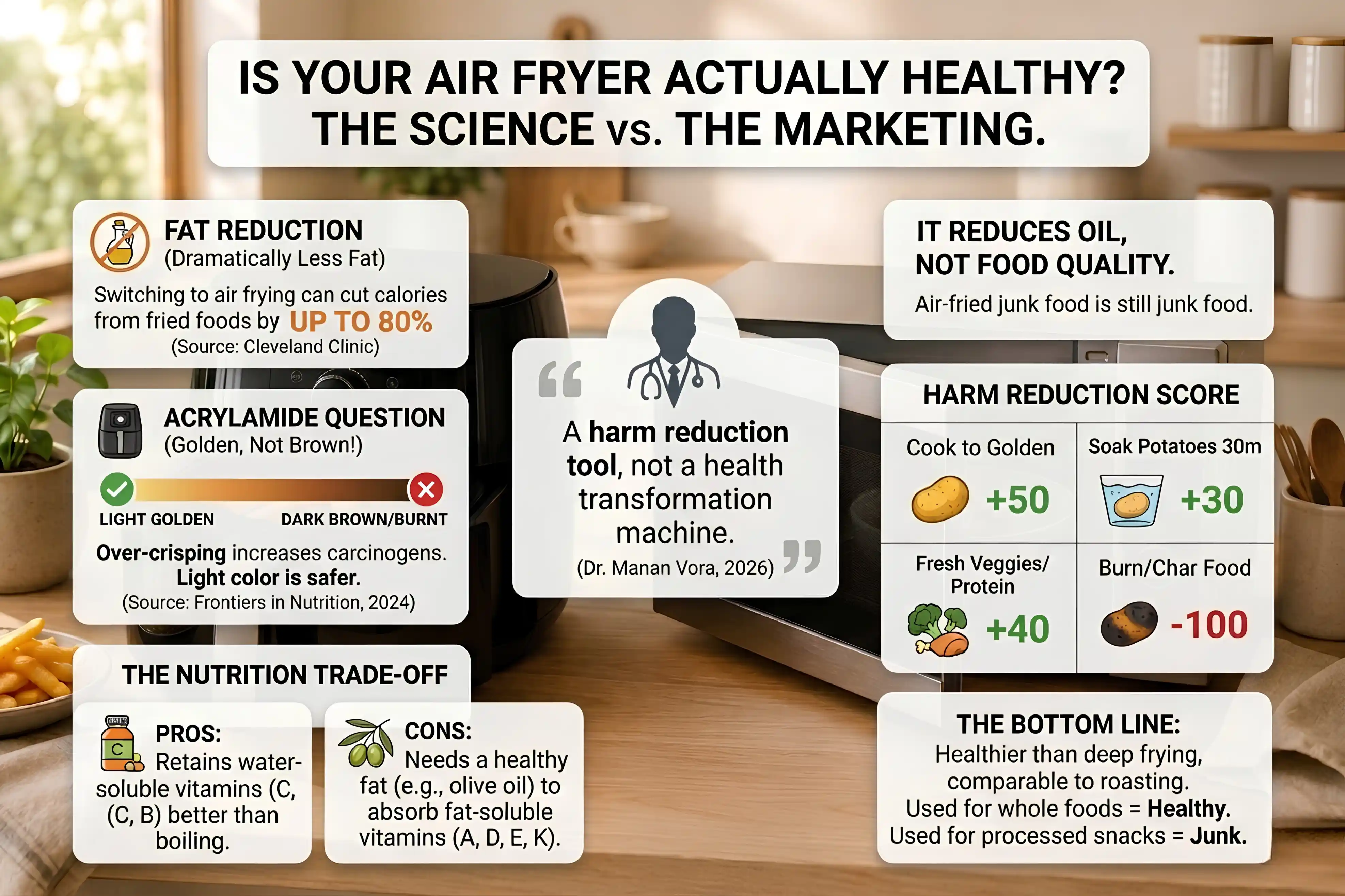
Air fryers are marketed as a guilt-free way to eat fried food. The reality is more nuanced. Here's what the research actually shows about fat reduction, acrylamide, nutrient retention, and whether your air fryer is really making your food healthier.
Most of us bought an air fryer because we wanted to eat fries for dinner without the side of guilt.
The marketing made it sound like a health pass. Crispy food, barely any oil, all the texture of deep frying without the consequences. And there's truth to that - air fryers truly do reduce some of the worst parts of fried food. But the "air fryers are healthy" claim has been stretched well past what the science actually supports.
Here is the honest version. An air fryer is a tool that can make some food choices less harmful. It is not a machine that turns unhealthy food into healthy food. Those are very different claims, and the difference matters.
Let me walk through what the research actually says - the real benefits, the real caveats, and the parts the marketing leaves out.
The real benefit: dramatically less fat
This is the part that's genuinely true and genuinely useful.
Deep frying submerges food in oil. The food absorbs a significant amount of that oil, which adds fat and calories. An air fryer uses circulating hot air and requires only about a tablespoon of oil, or sometimes none at all.
According to Cleveland Clinic, using an air fryer instead of deep frying may cut the calories you'd normally get from deep-fried foods by up to 80%. That's a real, substantial reduction. If you eat fried foods regularly, switching to an air fryer can meaningfully lower your fat and calorie intake without changing what you eat.
For people trying to reduce fat intake, manage weight, or cut calories while still enjoying the textures they like, this is the strongest argument for an air fryer. It's not marketing hype. The fat reduction is real and well-documented.
The acrylamide question
Here's where it gets more complicated, and where the marketing goes quiet.
Acrylamide is a compound that forms when starchy foods are cooked at high temperatures. Potatoes, bread, and grains all produce it when heated above about 248°F. It's a byproduct of the Maillard reaction - the same chemistry that browns food and makes it taste good.
The National Cancer Institute notes that acrylamide is classified as "probably carcinogenic to humans," based primarily on animal studies. Human evidence is much less clear, but it's generally considered something worth minimizing.
Here's the good news for air fryers: research shows air frying produces significantly less acrylamide than deep frying. According to Healthline, one study found air frying reduced acrylamide by up to 90% compared to traditional deep frying. That's a meaningful improvement.
Here's the caveat: a 2024 study published in Frontiers in Nutrition found that air-fried potatoes contained slightly more acrylamide than deep-fried or oven-fried potatoes in their specific test conditions. The results depend heavily on temperature, time, and how brown you let the food get.
The practical takeaway across all the research is consistent: acrylamide forms more the longer and hotter you cook starchy food. If you over-crisp or burn your food, acrylamide levels climb regardless of cooking method. A lightly golden air-fried potato has less acrylamide than a dark brown one. The browning is the variable that matters most, not the appliance.
The hidden vitamin trade-off nobody mentions
This one surprised me when I came across it, because it's never in the marketing.
Vitamins A, D, E, and K are fat-soluble. Your body needs dietary fat to absorb them. If you're air-frying vegetables with zero oil to be "healthy," you might actually be reducing how many of those vitamins your body can absorb from the food.
The flip side is also true and works in the air fryer's favor: because you're not boiling vegetables, you're not losing water-soluble B vitamins and vitamin C into the cooking water the way you would with boiling. Air frying retains those better than boiling does.
So the nutrient picture is mixed. Air frying preserves water-soluble vitamins better than boiling, but cooking with too little fat can reduce fat-soluble vitamin absorption. The reasonable middle ground is to use a small amount of healthy oil (olive, avocado) when air-frying vegetables, rather than going completely oil-free. A teaspoon helps your body absorb the nutrients without significantly adding calories.
The compounds beyond acrylamide
Acrylamide gets the headlines, but high-heat cooking produces other compounds worth knowing about.
Polycyclic aromatic hydrocarbons (PAHs) and heterocyclic amines (HCAs) form when meat is cooked at high temperatures. These are present in grilled, fried, and broiled meats regardless of method. Research published in Food Science and Biotechnology in 2024 found that air frying produces these compounds at levels comparable to or sometimes lower than other high-heat methods.
There's also some research, cited by Cleveland Clinic, suggesting that air frying fish can increase cholesterol oxidation products (COPs), which are linked to health concerns. This is specific to certain foods and cooking conditions, not a blanket problem.
None of this means air frying is dangerous. It means air frying, like all high-heat cooking, produces some compounds you'd want to limit. The same is true of grilling, roasting, and pan-frying. Air frying isn't uniquely problematic - it's just not uniquely protective either.
What doctors actually say
This framing, from Dr. Manan Vora (an orthopedic surgeon and sports medicine specialist) in a widely-shared 2026 explanation reported by Business Standard, captures it well: the air fryer is a harm reduction device, not a health transformation machine.
"Harm reduction" means minimizing damage when a behavior already exists, not turning that behavior into a virtue. If you're going to eat fries, air-fried fries are less harmful than deep-fried fries. That's the actual benefit.
What the air fryer cannot do is repair a nutritionally poor diet. Air-frying processed foods, frozen snacks, and refined-starch products doesn't make them healthy. It makes them slightly less unhealthy than the deep-fried version. The food itself is still what it is.
As Dr. Vora puts it: air fryers help when you're already making sensible food choices. Used wisely - to cook vegetables, lean proteins, and whole foods with less oil - they support healthier eating. Used to make endless batches of frozen mozzarella sticks, they're just a less-greasy way to eat junk.
So is it actually healthy? The honest answer
The air fryer is healthier than deep frying. Full stop. If you currently deep fry food and you switch to an air fryer, you will reduce your fat and calorie intake and probably reduce acrylamide too. That's a genuine health improvement.
The air fryer is not inherently healthier than other home cooking methods like roasting, steaming, or sautéing with a small amount of oil. It's roughly comparable, with different trade-offs for different foods.
The air fryer does not make unhealthy food healthy. Air-fried fries are still fries. Air-fried processed nuggets are still processed nuggets. The appliance reduces the oil, not the fundamental nutritional profile of the food.
What actually determines whether your air fryer makes you healthier is what you cook in it. Use it for vegetables, lean proteins, fish, and whole foods with a little good oil, and it's a genuinely healthy cooking tool. Use it exclusively for frozen snacks and starchy treats, and it's a marginally-better way to eat the same junk.
How to use an air fryer in a genuinely healthy way
If you want to maximize the health benefits, here's what the research points toward:
Cook to golden, not dark brown. Acrylamide and other compounds increase the more you brown and char food. Light golden is the target.
Use a small amount of healthy oil rather than none. A teaspoon of olive or avocado oil helps absorb fat-soluble vitamins and adds minimal calories. Completely oil-free isn't necessarily healthier.
Cook whole foods more than processed ones. Air-fried fresh vegetables, fish, and lean proteins are genuinely healthy. Air-fried frozen processed snacks are not, regardless of the appliance.
Don't burn your food. Burnt food has the highest levels of acrylamide, PAHs, and other compounds. If something comes out charred, the healthier move is to not eat the burnt parts.
Soak potatoes before air-frying. Soaking cut potatoes in water for 15-30 minutes before cooking reduces acrylamide formation significantly.
Vary your cooking methods. No single cooking method is perfect. Rotating between air-frying, steaming, roasting, and sautéing gives you a varied nutrient profile and limits exposure to any one method's downsides.
The bottom line
An air fryer is a useful tool for eating less fat and fewer calories while keeping the textures you enjoy. It reduces some harmful compounds compared to deep frying. It preserves some vitamins better than boiling.
It is not a health miracle. It will not make junk food healthy. It will not compensate for a poor overall diet. And used carelessly - with burnt food or exclusively for processed snacks - it loses most of its health advantages.
Think of it the way Dr. Vora frames it: a harm reduction device, not a health transformation machine. Used wisely, it genuinely supports healthier eating. Used as a guilt-eraser for junk food, it's just a fan and a heating element.
For more on whether air fryers are safe in terms of cancer risk specifically, our guide on air fryers and cancer covers the acrylamide and coating questions in depth. For concerns about the materials your food contacts, our non-toxic air fryer guide covers PFAS-free options. And for the complete picture on these appliances, our complete guide to air fryers is the foundation.
Sources and further reading
The information in this article is based on the following sources. We encourage you to read them directly for more detail:
- Cleveland Clinic - Are Air Fryers Healthy?
- Healthline - Is Cooking with an Air Fryer Healthy?
- Frontiers in Nutrition (2024) - Acrylamide formation in air-fried versus deep and oven-fried potatoes
- Food Science and Biotechnology (2024) - Effect of air-frying on formation of PAHs, acrylamide, and heterocyclic aromatic amines
- National Cancer Institute - Acrylamide and Cancer Risk
- Business Standard (2026) - Why your air fryer may be working against your health goals
This article is for general informational purposes and is not medical or nutritional advice. Consult a healthcare professional for guidance specific to your situation.
Yes, clearly. Air frying uses up to 80% less oil than deep frying, which significantly reduces fat and calorie content. It also produces less acrylamide in most conditions. If you currently deep fry, switching to an air fryer is a genuine health improvement.
There's no credible evidence that normal air fryer use causes cancer. The concern centers on acrylamide, which forms in any high-heat cooking method. Air frying typically produces less acrylamide than deep frying. Cooking to golden rather than dark brown minimizes it further.
Air frying reduces the calories that come from absorbed cooking oil - up to 80% compared to deep frying. But the base food's calories don't change. Air-fried fries have fewer calories than deep-fried fries, but they're still potatoes cooked with some oil. The appliance reduces added fat, not the food's inherent calories.
Yes, if you're cooking healthy foods in it. Daily air frying of vegetables, lean proteins, and whole foods is perfectly healthy. Daily air frying of processed snacks is no healthier than the food itself. The frequency matters less than what you're cooking.
Air frying preserves water-soluble vitamins (B vitamins, vitamin C) better than boiling because nutrients aren't lost into cooking water. However, cooking with zero oil can reduce absorption of fat-soluble vitamins (A, D, E, K). Using a small amount of oil addresses this.
A small amount (a teaspoon) of healthy oil like olive or avocado is actually beneficial - it helps your body absorb fat-soluble vitamins from vegetables and adds minimal calories. Completely oil-free cooking isn't necessarily healthier for nutrient absorption.
Indirectly. By reducing the oil and calories in foods you'd otherwise deep fry, an air fryer can support a calorie deficit. But it's a tool, not a weight-loss solution. What you cook and how much you eat matter far more than the appliance.
The cooking method doesn't make food processed - the food itself does. Air-frying fresh vegetables produces healthy food. Air-frying frozen processed snacks produces processed food that's slightly less greasy. The healthiness depends entirely on the ingredients, not the appliance.
The main considerations are acrylamide (in over-browned starchy foods), compounds from high-heat meat cooking (PAHs, HCAs - common to all high-heat methods), and potential concerns about non-stick coatings if they're damaged or overheated. None of these are unique dangers; they apply to most high-heat cooking.
Fresh vegetables (broccoli, brussels sprouts, cauliflower, sweet potatoes) with a small amount of olive oil, lean proteins like chicken breast and fish, and whole foods generally. These maximize the air fryer's benefits - less oil, retained nutrients, good texture - without the downsides of cooking processed foods.