Table of Contents
AI Summary
Best Air Fryers for Small Apartments in 2026

I cook in a 400 square foot apartment with about 18 inches of usable counter space. Here are the air fryers that actually work in spaces like mine - tested over six weeks of normal home cooking, not lab conditions.
The first air fryer I bought was too big.
It was a 6-quart oven-style model with rotisserie attachments, three trays, and a footprint approximately the size of a microwave. I lived in a 400 square foot studio at the time. The fryer took up half my counter, blocked the only outlet I had near the sink, and made me move it every time I wanted to chop vegetables. After two months of this, I sold it on Facebook Marketplace for forty dollars and bought something half its size.
That experience taught me something the marketing for these things does not tell you. The right air fryer for a small space is not the most powerful one or the most feature-packed one. It is the one you can actually leave on your counter without it ruining your kitchen.
This guide is for anyone cooking in small spaces. Studio apartments, dorms, tiny rentals where the kitchen is really just one wall of the living room, RV kitchens, vacation cabins, small kitchens of every kind. Anywhere counter space is a real constraint instead of an abstract concept - whether you call it a small apartment, a small kitchen, or just not enough room - the problem is the same.
I tested twelve air fryers over six weeks. Some were great. Some were obviously designed by people who had never cooked in a small kitchen.
What "small kitchen" actually means
Before we get to the picks, it's worth being specific about what we're solving for, because the air fryer market uses "compact" loosely.
When I say small kitchen, I mean a counter that is somewhere between 18 and 36 inches wide. Maybe a single under-cabinet outlet you have to share with a coffee maker. Possibly an upper cabinet 16 inches above the counter, which means the fryer cannot vent straight up without melting the wood above it.
These are real constraints, and they're the same ones whether you're cooking in a small apartment, a small kitchen in an older house, or any other genuinely small space. A lot of "best air fryer" articles will recommend something that is technically small but still requires nine inches of clearance on every side, which nobody has in a tiny kitchen.
The numbers I was looking for in this round of testing:
A footprint under 11 inches wide and 12 inches deep. Anything bigger and you cannot leave it out permanently.
Vertical clearance of 6 inches or less above the unit. Most basket-style fryers vent forward or sideways, but a few vent up, and those will damage your cabinets over time.
A reasonable weight. Anything heavier than 12 pounds is annoying to move around, which matters because in a small kitchen you will move it.
A cord long enough to reach an outlet that is not right behind the fryer. The shortest cord I tested was 24 inches, which is useless. You need at least 36 inches.
My top pick: Instant Vortex Plus 4-Quart
I have been using the Instant Vortex Plus 4-quart for almost two years now and it is the appliance I would buy again without hesitation.
The footprint is 10.12 inches wide and 12.87 inches deep. It fits under a standard upper cabinet without complaint. It weighs about 10 pounds, which is light enough that I can lift it to clean under it without making it a project.
The thing that sold me, honestly, was not the cooking performance. The cooking performance is good but most basket-style fryers in this size class cook food adequately. What sold me was the design choices that make daily living with the appliance painless.
The basket and tray are both dishwasher safe. This sounds like a small thing until you have washed an air fryer basket by hand every other day for a month. The non-dishwasher-safe ones get worse over time as residue builds up in places you cannot reach with a sponge. Just spend the extra money for dishwasher safe.
The display is a flat panel with one set of controls - temperature, time, and a few preset buttons you will mostly ignore. It does not have any wifi connectivity, app integration, or voice control. I count this as a positive. Smart features in kitchen appliances are almost always solving a problem nobody actually has.
The only real complaint I have is the noise. It is not quiet. At full speed it is around 65 decibels, which is louder than my dishwasher. If you live somewhere with thin walls or you use the fryer late at night, you will be aware of the sound. I have gotten used to it but if you are a noise-sensitive person, look at the runner-up below instead.
Price: typically around $90, sometimes lower during sales.
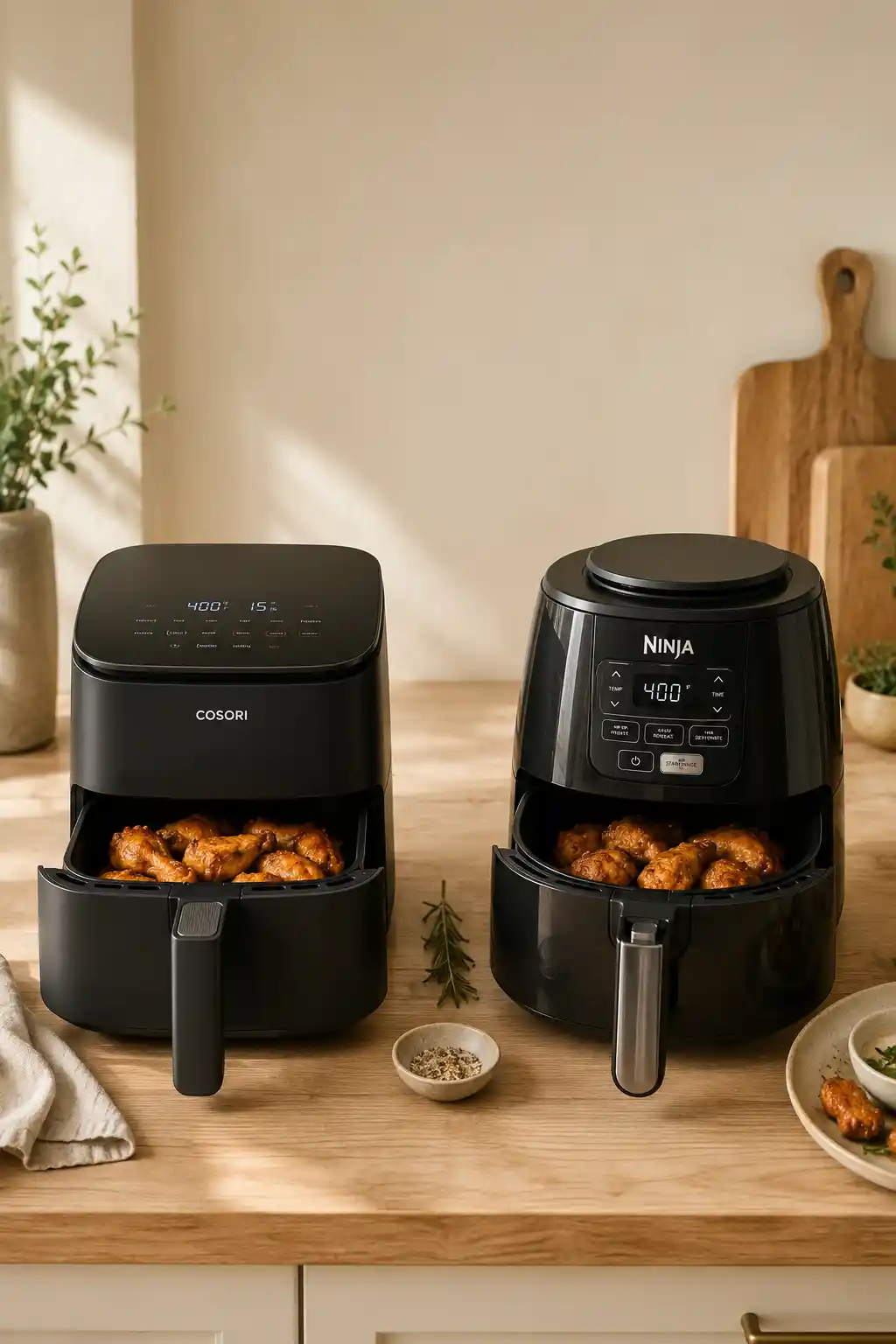
Runner-up: Cosori Pro LE 5-Quart
If the Vortex is unavailable, or if you specifically want a fryer that is quieter, the Cosori Pro LE is a strong second choice.
The footprint is slightly larger - 10.8 inches by 14.4 inches - but the difference is not noticeable in practice. What you get for the slightly bigger size is meaningfully quieter operation, around 53 decibels at full speed. That is closer to a quiet conversation than a vacuum cleaner.
The Cosori has a square basket instead of a round one. This sounds like a minor difference but it matters more than I expected. Square baskets fit sandwiches, slices of pizza, and tray-shaped foods better than round baskets. Round baskets are fine for fries and wings but anything flat ends up wedged at an angle.
The downside is the controls. The Cosori uses a touchscreen interface instead of buttons, and after a few months of cooking with greasy hands, the touchscreen gets smudged enough that it sometimes does not register taps. You can clean it but you have to clean it often. Physical buttons would have been better.
Price: typically around $100.
Ninja AF101 5-Quart
The Ninja AF101 is the air fryer I'd tell most people to buy. Not because it does everything, but because it does the right things without getting in its own way.
It's compact - roughly 11.29 by 14.84 inches - so it fits without claiming half the counter. The 5-quart basket works for one or two people. Families will want something bigger.
Using it takes about 30 seconds to figure out. No app, no wifi, no touchscreen. A dial for temperature, a button for mode, a timer. After testing appliances that make you feel like you need a tutorial just to reheat leftovers, this was a relief. Cooking performance is good. Fries come out crispy, frozen food heats evenly, wings and vegetables work without much trial and error. The fan stays consistent and the temperature held steadier than I expected for the price. Reheating leftovers also works better than it has any right to.
Cleanup is easy - the basket goes in the dishwasher, which sounds like a small thing until you've owned an air fryer that becomes annoying to clean and ends up stuffed in a cabinet. The nonstick held up fine over time, as long as you avoid metal utensils.
The build is functional. Lighter plastic, a handle with a slight wobble if you're paying close attention. Nothing felt fragile, but it's not going to impress anyone.
Two things that genuinely bugged me. The power cord is short enough that you'll need to think about where your outlet is before you decide where the fryer lives. And the round basket makes square foods awkward - sandwiches and pizza slices don't sit right, which matters more depending on what you actually cook. Noise is noticeable but never distracting.
Price around $90 to $120 depending on sales.
Best Air Fryers for Cooking in Small Spaces
If you've landed here searching for the best air fryers for cooking in small spaces, here's the short version of everything above. "Small spaces" covers more than apartments - studios, dorm rooms, RV galleys, vacation cabins, boat kitchens, and any tiny kitchen where the counter is the bottleneck. The good news is that the same picks that work in a small apartment work in all of these, because the constraint is identical: a footprint you can leave out permanently without losing the counter.
For most small spaces, the Instant Vortex Plus 4-Quart is the best all-around choice - a 10.12 × 12.87 inch footprint, about 10 pounds, and it vents in a way that won't scorch a low cabinet above it. If you want quieter operation and have a couple of extra inches to spare, the Cosori Pro LE 5-Quart is the pick. And for the genuinely smallest spaces - an RV counter, a dorm shelf, a kitchen too narrow for anything else - the Dash Compact 2.6-Quart fits where nothing else will, as long as you're cooking for one and don't mind doing it in batches.
The thing to ignore when shopping for small spaces is wattage bragging and feature lists. A fryer that cooks slightly faster doesn't help if it doesn't fit. In a tight cooking space, the footprint and the cord length decide whether you'll actually use the thing - everything else is secondary.
What about the toaster oven style fryers?
Several readers have asked me about the larger oven-style air fryers - the ones with a glass door, multiple trays, and a rotisserie spit. Brands like Cuisinart, Breville, and Ninja all make these.
For small kitchens, I cannot recommend them. They are excellent appliances if you have the space, but they are not really competing in the same category as basket fryers. They are bigger, they take up more counter, they have more parts to clean, and they cost more.
If you have enough counter space for one, you probably do not have a small kitchen and this guide is not for you.
The one exception is if you would also be using the appliance to replace your toaster oven entirely. In that case, the math sometimes works out - you free up the counter space your old toaster oven was using, and you end up net-positive on space. But that is a specific situation, not a general recommendation.
What I tested but did not include
I want to be transparent about the units that did not make it into the recommendations.
The Chefman 4-Quart looked promising on paper but had real temperature accuracy issues. I ran a thermometer test and at the "400 degree" setting, the actual cavity temperature was closer to 365. Food came out slightly undercooked in the times the recipes called for. Not a dealbreaker, but you have to compensate by cooking longer, and that defeats some of the point of an air fryer.
The Gourmia 4-Quart is one of the cheapest fryers on Amazon. It is about $40. I tested it because some readers asked me to. The cooking was acceptable. The plastic smell never fully went away after two weeks of regular use. I had to wash the basket more often because residue stuck to it more readily. After a month, the touchscreen had stopped responding to taps about 30 percent of the time. I would not buy it again.
The Dash Compact 2-Quart is the smallest fryer I tested. It is genuinely tiny. The footprint is about 8 inches by 10.5 inches. If you have a really, truly minimal kitchen, this is worth considering. But the basket is so small that even one chicken breast fills it completely. You will be cooking in batches for almost everything except solo meals. That trade-off is a personal call.
The Philips Premium XXL has the best cooking performance of anything I tested. It also costs $300, takes up enormous counter space, and has features most people will never use. It is for people who are deeply serious about air frying and have plenty of kitchen real estate. Not this guide.
Quick comparison
Here is everything in one place:
| Model | Price | Capacity | Footprint | Noise | Dishwasher safe |
|---|---|---|---|---|---|
| Instant Vortex Plus | $90 | 4 qt | 10.12 × 12.87 in | 65 dB | Yes |
| Cosori Pro LE | $100 | 5 qt | 10.8 × 14.4 in | 53 dB | Yes |
| Ninja AF101 | $90 | 5 qt | 11.29 × 14.84 in | 62 dB | Yes |
| Chefman 4-Quart | $59.91 | 4 qt | 10 × 13.8 in | 60 dB | Yes |
| Dash Compact | $50 | 2.6 qt | 8 × 10.5 in | 58 dB | Yes |
Where to Buy a Compact Air Fryer
Once you know which compact air fryer you want for your small kitchen, finding one is easy - every model in this guide is sold at the major retailers. Amazon usually has the widest selection and, more importantly, the deepest pool of user reviews, which is the single best place to spot the daily-use problems (touchscreen failures, plastic smell, short cords) that don't show up in product photos. Walmart and Target both stock the Instant, Cosori, Ninja, and Dash models and frequently match Amazon's sale pricing, with the bonus that you can buy online and pick up in store. Best Buy carries the same brands and is worth checking if you want to see the actual footprint in person before committing.
Buying directly from the manufacturer sites - Instant, Cosori, Ninja, Dash - is the other reliable option. Prices are usually similar to Amazon, but manufacturer sites sometimes run their own promotions and tend to have the clearest warranty registration and replacement-part ordering, which matters if a basket coating wears out down the line.
Wherever you buy, the one thing to verify before checkout is the exact footprint. "Compact" is a marketing word, not a measurement, and a few models labeled compact still need nine inches of clearance you won't have in a tiny kitchen. Pull the width and depth dimensions from the listing and measure your counter first - that one check prevents the most common small-kitchen buying mistake.
How I actually tested these
For anyone wondering how I came to these conclusions, here is the methodology.
Each fryer cooked the same five test dishes: frozen french fries, chicken wings, brussels sprouts, salmon filets, and reheated pizza slices. I used identical ingredients across all units and did not adjust the recipes between tests. The goal was to see how the fryers performed at the same task, not to optimize for each one.
I measured temperature accuracy with a digital probe thermometer at four different times during cooking. I measured noise with a decibel meter app held two feet from the unit at the loudest fan setting.
I lived with each fryer for at least four days as my primary cooking appliance, which means I cooked breakfast, lunch, and dinner with it where possible. This is the part that exposed the daily-use issues - the touchscreen problems, the basket cleaning struggles, the cord length annoyances. None of that shows up in a 30-minute review.
The kitchen I tested in is a 400 square foot studio apartment with 18 inches of usable counter space. Some of these fryers genuinely did not fit in that space. Those got disqualified before any cooking happened.
What I would actually buy if I were starting over
If I had to do this all over again, knowing what I know now, I would buy the Instant Vortex Plus 4-quart. The end.
It is not the cheapest. It is not the most feature-packed. It is not the quietest. But it is the one that has been quietly working on my counter for two years without making me regret the purchase.
That is the actual test for a small-kitchen appliance. Not whether it is impressive in a review. Whether you can live with it.
If you want something quieter and you can stretch the budget by 20 dollars, the Cosori Pro LE is also a great call. If you genuinely cannot spend more than 60 dollars, the Ninja AF101 will not let you down.
For everything else, including the real basics like how an air fryer actually works and what these appliances are good for in the first place, our complete guide to air fryers covers more ground.
For a 4-quart basket fryer, plan on 12 inches of counter width minimum, plus a few inches of breathing room on each side for ventilation. The unit itself will be about 10 to 11 inches wide, but you do not want it pressed flush against a wall on every side.
Technically yes, but you probably will not. The whole appeal of an air fryer is convenience. If using it requires hauling it out of a cabinet, plugging it in, and finding counter space, you will skip it half the time. They are designed to live on the counter.
Not really. The cooking technology is the same - hot air, fast fan. A 2-quart fryer cooks food the same way a 6-quart fryer does. The difference is just how much you can fit at once. If you cook for one or two people, a smaller unit will not let you down.
These are the toaster-oven style models. They take up significantly more counter space and cost two to three times as much. For a small kitchen, they are not the right tool.
Most air fryers draw between 1300 and 1700 watts. A standard 15-amp circuit can handle about 1800 watts before tripping. If you run an air fryer at the same time as a microwave or toaster on the same circuit, you might trip the breaker. Use them on different circuits where possible.
For most small spaces - studios, dorms, RVs, and tiny kitchens - the Instant Vortex Plus 4-Quart is the best overall pick because its sub-11-inch footprint fits under standard cabinets and it's light enough to move easily. If counter space is extremely tight, the Dash Compact 2.6-Quart fits where nothing else does, at the cost of smaller batches. The right fryer for a small space is the one you can leave out permanently without it taking over the counter.
Compact air fryers are widely available at Amazon, Walmart, Target, and Best Buy, as well as directly from manufacturer sites like Instant, Cosori, and Ninja. Amazon usually has the widest selection and the most user reviews to cross-check; Walmart and Target often match sale pricing in store. Whichever retailer you use, confirm the exact footprint dimensions on the listing before buying, since 'compact' is used loosely.
For a tiny kitchen, a 2 to 4-quart basket fryer hits the sweet spot - large enough to cook for one or two people, small enough to leave on the counter. A 4-quart model like the Instant Vortex Plus suits most solo cooks and couples; drop to a 2 to 2.6-quart Dash Compact only if your counter is genuinely too narrow for anything bigger. Above 5 quarts, the footprint usually outgrows a tiny kitchen.