Table of Contents
AI Summary
How Much Electricity Does an Air Fryer Actually Use? (With Real Cost Math)

Air fryers are marketed as energy-efficient, but what does that mean for your electricity bill? Here's the real math on watts, cost per use, and how air fryers actually compare to your oven and microwave.
"Air fryers are energy efficient" is one of those claims everyone repeats but nobody actually quantifies.
So let me quantify it. The short version: a typical air fryer costs about 11 cents to run for a 30-minute cook at average US electricity rates. Over a month of daily use, that's somewhere between $2 and $8 added to your bill. It's truly cheap to run, but the "efficiency" claim has some nuance worth understanding - air fryers aren't magically free, and they're not more efficient than everything.
Here's the actual math, where the efficiency claim holds up, and where it doesn't.
The wattage: what your air fryer actually draws
Air fryers draw between 800 and 2,000 watts, depending on size and model. Most of the popular ones land in the 1,400 to 1,700 watt range.
Smaller models (1-3 quart) typically use 700-1,200 watts. Larger models (4-6 quart) use 1,500-1,800 watts. A few high-powered units hit 2,000 watts.
Here's the thing that trips people up: the wattage rating is the maximum draw, not the constant draw. An air fryer rated at 1,500 watts doesn't pull 1,500 watts the entire time it's running. Once it reaches temperature, it cycles the heating element on and off to maintain the temperature, drawing less on average. The fan uses very little power - almost all the consumption is the heating element.
This is why "rated wattage" overstates actual energy use slightly. But for estimating costs, using the rated wattage gives you a safe upper-bound number.
The real cost math
Here's the formula. It's simple enough to do on your phone:
Cost = (Watts ÷ 1,000) × Hours Used × Your Electricity Rate
Let's use a typical 1,500-watt air fryer and the average US electricity rate of about $0.15 per kWh (yours might be higher or lower - check your bill).
A 10-minute snack: (1,500 ÷ 1,000) × 0.17 hours × $0.15 = about $0.04
A 30-minute dinner: (1,500 ÷ 1,000) × 0.5 hours × $0.15 = about $0.11
A 60-minute roast: (1,500 ÷ 1,000) × 1 hour × $0.15 = about $0.23
So a typical air fryer meal costs somewhere between four cents and a quarter, depending on how long you cook. That's the whole answer to "how much does it cost to run."
For the month: if you use the air fryer 30 minutes a day, every day, that's about $0.11 × 30 = roughly $3.30 per month. Heavier use lands you in the $5-8 range. Light use, under $3.
How to find your actual rate
The numbers above use $0.15/kWh, which is roughly the US average. But electricity rates vary a lot by state - from around $0.10/kWh in some areas to over $0.30/kWh in places like California and Hawaii.
To get your real cost, find your rate on your electricity bill. It's listed as a price per kWh (kilowatt-hour). Plug that number into the formula instead of $0.15.
If your rate is $0.25/kWh (higher than average), that 30-minute dinner costs about $0.19 instead of $0.11. Still cheap, just proportionally more.
Air fryer vs oven: where efficiency actually wins
This is where the "energy efficient" claim earns its keep.
A conventional electric oven draws 2,000-5,000 watts - significantly more than an air fryer. Worse, an oven takes 10-15 minutes just to preheat before you even start cooking, and it heats a large cavity you're mostly not using when cooking small portions.
An air fryer preheats in 2-3 minutes (some don't need preheating at all), heats a small cavity, and cooks faster because the concentrated hot air transfers heat efficiently.
For a small-to-medium meal - a couple of chicken breasts, a tray of vegetables, a batch of fries - the air fryer uses substantially less total energy than firing up a full oven. You're not paying to heat a big empty box.
This is the real efficiency story: not that air fryers use little power, but that they avoid the waste of heating a large oven cavity for a small amount of food.
The exception: if you're cooking a large meal that genuinely fills an oven - a whole roast plus multiple sides, a big batch of cookies - the oven can be more efficient per unit of food, because you're using all that heated space. Air fryers win for small portions; ovens can win for large ones.
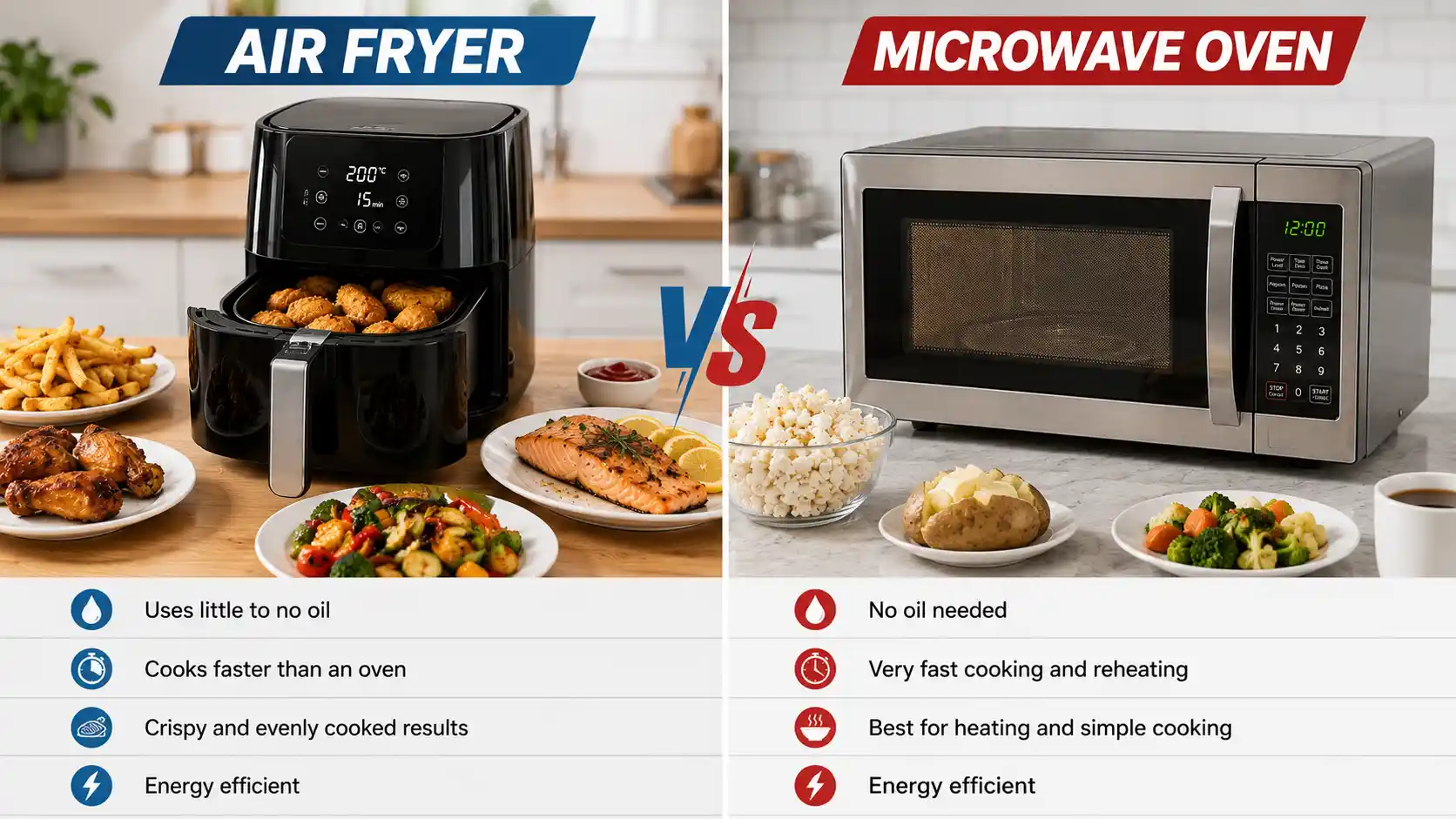
Air fryer vs microwave: microwave usually wins on efficiency
People often assume the air fryer is the most efficient appliance in the kitchen. For some tasks, the microwave beats it.
Microwaves heat food directly by exciting water molecules, without heating the surrounding cavity much. For simple reheating - a bowl of soup, leftovers, a cup of coffee - the microwave uses less energy and finishes faster.
The air fryer has to heat the air around the food, which means some energy goes into heating the cavity rather than the food itself. For reheating, that's less efficient than the microwave's direct approach.
But the microwave can't crisp or brown. So the comparison isn't really about efficiency - it's about what result you want. If you want crispy reheated pizza, the air fryer's slightly higher energy use is worth it because the microwave physically can't deliver that texture. We covered this fully in our air fryer vs microwave comparison.
What actually drives your air fryer's energy use
A few factors determine how much electricity any given cook uses.
Temperature. Higher settings use more energy. Cooking at 400°F draws more power than 300°F because the unit works harder to reach and hold the higher temperature.
Cooking time. Longer cooks use more total energy, obviously. But air fryers cook faster than ovens, which partly offsets this.
Basket load. A full basket requires more energy than a partial one - the unit works harder to circulate heat around more food. But cooking a full batch once is more efficient than cooking several small batches separately.
Opening the basket. Every time you pull the basket out to check or shake, heat escapes and the unit has to work to recover. Minimize unnecessary opening.
Room temperature. An air fryer in a cold room uses slightly more energy to reach temperature. Minor factor, but real.
How to lower your air fryer's running cost
If you want to minimize energy use, here's what actually helps.
Skip preheating on modern fast-heating models. Many newer air fryers reach temperature so fast that preheating is optional. Check whether yours actually needs it.
Cook full batches rather than several small ones. One full basket uses less total energy than three half-batches.
Don't open the basket more than necessary. Each opening releases heat. Shake when the recipe says to, but don't keep checking.
Use the lowest effective temperature. If something cooks fine at 350°F, don't use 400°F.
Match fryer size to your needs. A giant 8-quart fryer cooking a single chicken breast wastes energy heating empty space. If you cook small portions, a smaller fryer is more efficient.
None of these will transform your electricity bill - air fryers are cheap to run regardless. But they add up over time and they're easy habits.
The bottom line
An air fryer costs roughly 4 to 23 cents per use, depending on cooking time, at average US electricity rates. Over a month of regular use, expect it to add $2-8 to your bill.
It's genuinely cheap to run, and it's more efficient than an oven for small meals because it doesn't waste energy heating a large cavity. It's slightly less efficient than a microwave for simple reheating, but it does things the microwave can't.
The "energy efficient" claim is true, with the nuance that the efficiency comes from cooking small portions quickly in a small space - not from the appliance using little power in absolute terms. Used for what it's good at, an air fryer is one of the cheaper ways to cook a meal.
For more on how air fryers compare to other appliances, our air fryer vs convection oven guide and air fryer vs microwave guide go deeper. For the complete picture on these appliances, our complete guide to air fryers covers everything.
Sources and further reading
The information in this article is based on the following sources:
- Energy Use Calculator - "Electricity usage of an Air Fryer"
- The Air Fryer Insider - "Air Fryer Power Consumption: Complete Energy Usage Guide"
- Ideal Home - "How much does it cost to run an air fryer?"
- Uswitch - "Are air fryers cheap to run? Costs vs. ovens"
Electricity rates vary significantly by location. The costs in this article use the approximate US average of $0.15/kWh. Check your electricity bill for your actual rate to calculate precise costs.
For a typical 1,500-watt air fryer running 30 minutes at the average US electricity rate of about $0.15/kWh, it costs roughly $0.11 per use. A quick 10-minute snack costs about $0.04, and a longer 60-minute roast costs around $0.23. For most households cooking daily, an air fryer adds $2-8 to the monthly electricity bill.
Not really. Air fryers draw 800-2,000 watts (most are 1,400-1,700W), which sounds like a lot, but they cook quickly and the cavity is small. Per meal, they use less electricity than a conventional oven for small-to-medium portions, though slightly more than a microwave for simple reheating.
For small to medium meals, yes. A conventional electric oven draws 2,000-5,000 watts and takes 10-15 minutes just to preheat. An air fryer preheats in 2-3 minutes and cooks faster. For cooking small portions, the air fryer uses significantly less total energy. For large meals that fill an oven, the oven can be more efficient per unit of food.
Use this formula: (Watts ÷ 1,000) × Hours Used × Your Electricity Rate. For example, a 1,500W air fryer for 30 minutes at $0.15/kWh: (1500 ÷ 1000) × 0.5 × 0.15 = about $0.11. Find your exact rate on your electricity bill (it's listed as cost per kWh).
Per hour, yes - but higher wattage often cooks faster, so total energy use can be similar. A 1,700W air fryer cooking something in 15 minutes may use about the same total energy as a 1,400W model taking 20 minutes for the same food. Wattage affects speed more than total cost.
For simple reheating, the microwave is usually cheaper because it heats food directly and finishes faster. For cooking that requires crisping or browning, the air fryer is worth the slightly higher energy use because the microwave can't produce those results. They serve different purposes.
The heating element, by far. The fan uses minimal power. Higher temperature settings and longer cooking times drive up consumption. Cooking at 400°F uses more energy than 300°F, and a full basket requires more energy than a partial one because the unit works harder to circulate heat around more food.
Yes. Skip unnecessary preheating on modern models that heat fast. Cook in full batches rather than many small ones. Don't open the basket more than needed (it releases heat). Use the lowest temperature that gets the job done. And match the fryer size to your needs - a giant fryer cooking small portions wastes energy heating empty space.
For most households, no. Daily air fryer use typically adds $2-8 per month. If you're replacing oven cooking with air fryer cooking for small meals, you may actually see a net reduction in your cooking energy costs because the air fryer is more efficient for those portions.