Table of Contents
AI Summary
How to Cook Salmon in an Air Fryer (Fresh or Frozen)
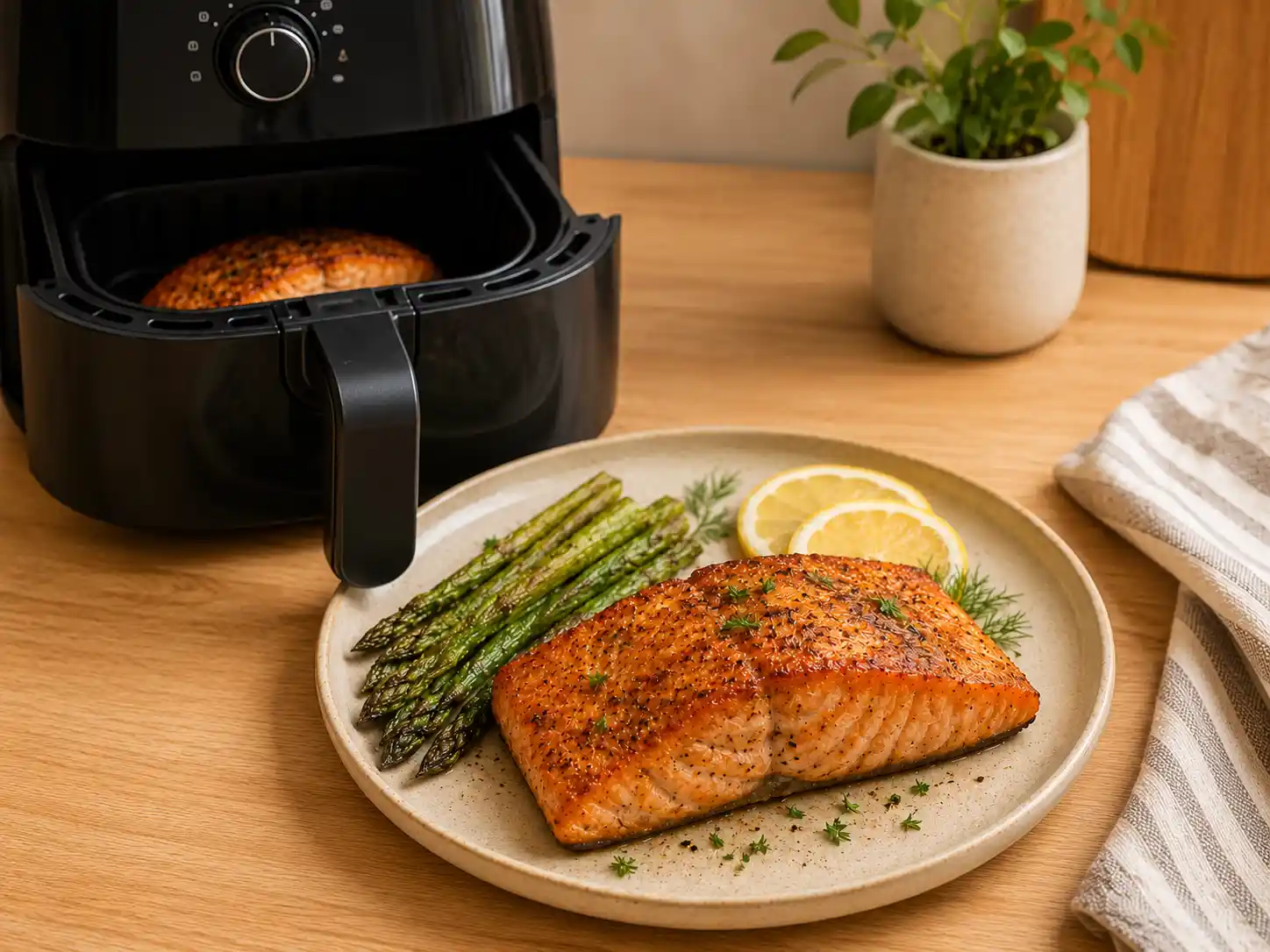
Perfectly flaky salmon in under 15 minutes, no flipping, no babysitting - and it works straight from frozen too. Here's the exact temperature, timing, and doneness guide for getting it right every time.
Salmon might be the single best argument for owning an air fryer. It comes out flaky and evenly cooked with a light crust, takes under 15 minutes, and - unlike most proteins - doesn't even require flipping.
It also happens to be one of the most forgiving foods to cook this way, which makes it a good one to have memorized. Here's the exact temperature and timing guide, for both fresh and frozen fillets, along with the mistakes that actually matter.
Fresh salmon: temperature and time
For fresh salmon fillets, the consistent range across tested methods is 390-400°F for 7-9 minutes, with the exact time depending on thickness and the type of salmon.
Thinner wild-caught fillets (leaner and generally thinner-cut than farmed) cook faster - around 5-7 minutes at 390°F. Thicker farm-raised fillets need closer to the full 7-9 minutes at 400°F.
No need to preheat for long - 3-5 minutes is plenty. Season the fillets (salt, pepper, a squeeze of lemon, or your preferred spice blend), place them skin-side down if they have skin, and cook without flipping. The air circulates from all directions, so both sides cook evenly on their own.
Frozen salmon: no thawing required
This is where the air fryer truly earns its keep - you can go from freezer to plate without planning ahead.
Cook frozen fillets at 390-400°F for roughly 12-16 minutes total, depending on thickness. Because frozen fillets vary more in how they cook, checking internal temperature matters more here than watching the clock.
One reliable approach: air fry the frozen fillets for 5-7 minutes first (this thaws them enough to separate and season), then brush on any seasoning or glaze and continue cooking for another 7-9 minutes until done. This two-stage approach also gives a glaze time to caramelize in the second half of cooking without burning early on.
Whichever method you use, avoid partially thawing the salmon before starting - cooking times are calibrated for either fully frozen or fully fresh, and a partial thaw throws off the timing in unpredictable ways.
How to know it's actually done
Don't guess by time alone - thickness varies fillet to fillet, and overcooking is the single most common way to ruin air fryer salmon.
The reliable method is an instant-read thermometer at the thickest part of the fillet. The FDA's recommended safe internal temperature for salmon is 145°F. Since the temperature continues climbing slightly after you remove it from the heat (carryover cooking), many experienced cooks pull the salmon at 135-140°F and let it rest a few minutes to finish at 145°F.
If you prefer a more tender, medium texture rather than fully well-done, some cooks target 125-130°F instead - this is a matter of personal preference regarding texture, not a food safety recommendation. The FDA's guidance is 145°F.
Visually, properly cooked salmon turns opaque (not translucent) and flakes easily when pressed with a fork. If it still looks glassy or resists flaking, it needs more time.
The mistakes that actually matter
A short list of what goes wrong, and how to avoid it.
Overcrowding the basket. This is the most common mistake. Too many fillets blocks air circulation, leading to uneven cooking - some parts done, others underdone. A 4-5 quart air fryer comfortably fits 2-3 fillets in a single layer. For more, cook in batches rather than stacking.
Skipping the thermometer. Cooking times are guidelines; actual doneness depends on thickness and your specific air fryer. A $10 instant-read thermometer removes the guesswork entirely and is worth owning if you cook protein regularly.
Partially thawing frozen salmon. As mentioned above, cook it either fully frozen or fully thawed - a partial thaw makes the timing unreliable.
Not using enough seasoning before cooking, then adding sauce too early. If you're using a glaze or sauce, brushing it on partway through (rather than at the very start) lets it caramelize without burning during the full cook time.
Do you need oil?
Only a little. Salmon has enough natural fat that it doesn't need oil to stay moist the way leaner proteins do. A light spray or brush of oil mainly helps seasoning stick and promotes even browning on the surface - not a functional necessity, just a nice-to-have for texture.
Reheating leftover salmon
The air fryer is a genuinely good way to reheat salmon, arguably better than the microwave, which tends to make fish rubbery and unevenly hot.
Reheat at 360-375°F for about 4-5 minutes, checking that it's warmed through without pushing it back into overcooked territory. Leftover salmon stored in an airtight container keeps for 3-4 days in the fridge.
Quick reference
For fast lookup:
Fresh salmon: 390-400°F, 7-9 minutes (thinner/wild-caught on the shorter end, thicker/farm-raised on the longer end). No flipping needed.
Frozen salmon: 390-400°F, 12-16 minutes total. Consider a two-stage approach - a few minutes to thaw, then season and finish cooking.
Doneness: 145°F internal temperature (FDA safe minimum), or 125-130°F for a more tender medium texture.
Reheating: 360-375°F, 4-5 minutes.
Air fryer size: 4-5 quart handles 2-3 fillets without overcrowding.
For more on getting the most out of your air fryer, our guide to foods that cook better in an air fryer covers other proteins and vegetables worth trying. For choosing the right size for your household, our complete guide's sizing section can help.
Sources and further reading
The information in this article is based on the following sources:
- StaySnatched - "Easy Air Fryer Salmon"
- Well Plated - "If You're Not Cooking Salmon in the Air Fryer Yet, Start Here"
- The Big Man's World - "Frozen Salmon In Air Fryer (No Thawing, 12 Minutes)"
- I Heart Umami - "Frozen salmon in an air fryer"
- U.S. Food and Drug Administration - Safe minimum internal cooking temperature guidance for seafood
Cooking times are approximate and vary by air fryer model and fillet thickness. Always confirm doneness with an instant-read thermometer rather than relying on time alone. The FDA recommends a minimum internal temperature of 145°F for seafood.
For fresh salmon fillets, cook at 390-400°F for 7-9 minutes, depending on thickness. Thinner wild-caught fillets need less time (5-7 minutes); thicker farm-raised fillets need closer to 9 minutes. Cook until the internal temperature reaches 145°F at the thickest part, per FDA guidance, or 125-130°F if you prefer a more tender, medium texture.
Yes, and it works well. Cook frozen salmon fillets at 390-400°F for about 12-16 minutes total, checking for doneness with a thermometer rather than relying on time alone, since thickness varies. Some methods air fry for 5-7 minutes first to thaw and separate the fillets, then season and continue cooking for another 7-9 minutes.
No. The air circulates around the fish from all directions, so it cooks evenly without flipping. Just place the fillets skin-side down (if they have skin) and let the air fryer do the work.
The most reliable method is an instant-read thermometer at the thickest part of the fillet. The FDA-recommended safe temperature is 145°F. Visually, done salmon looks opaque (not translucent) and flakes easily with a fork. Since temperature continues rising slightly after cooking, many cooks pull it 5-10 degrees early and let it rest.
Fresh generally yields slightly better texture and is more forgiving on timing. But frozen works well too and is genuinely convenient - you can cook it straight from the freezer with no thawing, which is useful on nights you forgot to plan ahead. Both are legitimate options; the difference in final quality is modest.
Reheat at 360-375°F for about 4-5 minutes, checking that it's warmed through without overcooking. The air fryer is one of the better ways to reheat salmon since it warms the fish without making it soggy the way a microwave can.
A 4-5 quart air fryer comfortably fits 2-3 fillets in a single layer without overcrowding. Overcrowding is the most common mistake - it blocks air circulation and leads to uneven cooking. If you're cooking for more people, cook in batches rather than stacking fillets.
A light coating helps the seasoning stick and promotes even browning, but salmon has enough natural fat that you don't need much - a light spray or brush is sufficient. Unlike leaner proteins, salmon doesn't require oil to stay moist.